
In Venice, Pierre Cardin’s former home has become a museum — but perhaps “museum” is too static a word for a designer who spent his entire life imagining what came next. There is something deeply appropriate about finding Pierre Cardin’s new house museum in Venice. Not Paris, where he built his career and became a global name, but in the city of his Italian origins, a place suspended between past and future, reality and illusion.
Located inside Palazzo Bragadin, the Venetian residence Cardin acquired and used for decades as a place to live, think and create, the new museum opened in September 2026, bringing together hundreds of pieces from his extraordinary archive. More than 350 works — including fashion, accessories, furniture, lamps and objects — trace a creative universe that was never confined to clothing. And this is perhaps the most interesting way to look at Cardin today. Before fashion became an ecosystem of collaborations, lifestyle extensions and multidisciplinary creative directors, Cardin had already understood that a designer could create an entire world rather than simply a wardrobe.




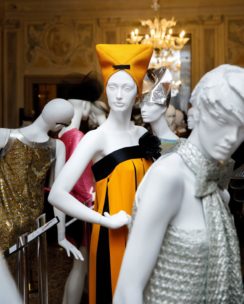
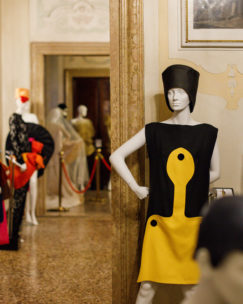
His vision crossed couture, ready-to-wear, architecture, interiors, furniture, accessories, hospitality and popular culture. In 1959, he famously introduced a ready-to-wear collection at Paris department store Printemps, helping to redefine the relationship between fashion and a wider public. He also created what became known as his Scultures Utilitaires: furniture, lamps and functional objects conceived with the same geometric language as his clothes. Walking through Palazzo Bragadintoday, these different aspects of his practice come together almost naturally. The clothes appear less like historical costumes than fragments of a future that never quite arrived. Metallic surfaces, sculptural silhouettes, circular constructions, vinyl, leather, exaggerated volumes and architectural cuts reveal a designer fascinated by movement, technology and the human body as a space for experimentation. Among the works on display are pieces dating from 1950 onwards, including the famous red pleated wool coat from 1952 and designs from the Space Age period that made Cardin one of the most recognisable visionaries of twentieth-century fashion. We should remember that much of what we now consider “normal” in fashion — gender-fluid silhouettes, the designer as brand, fashion crossing into architecture and interiors, collaborations across disciplines, the idea of a total lifestyle universe — was already present in Cardin’s work decades ago. His futurism was not simply an aesthetic. It was a business model, a cultural position and, above all, a way of thinking.
The House-Museum as a Living Archive
The museum is also the result of a deeply personal act of preservation by Rodrigo Basilicati-Cardin, Pierre Cardin’s nephew and president of the Maison. Having spent decades close to the designer, he has taken on the task of preserving and bringing new attention to an archive of extraordinary scale. Rather than treating the archive as something frozen in time, the project is conceived as a changing space. The selection will evolve, allowing different chapters of Cardin’s work to emerge over time.
This idea feels particularly relevant today, when fashion archives are increasingly becoming places of research, inspiration and reinterpretation rather than simply repositories of heritage. And perhaps this is where Cardin speaks most directly to a new generation. His work reminds us that innovation does not necessarily mean abandoning the past. Sometimes it means looking at an old idea again and asking what it could become now.
Coming Back to Venice
Cardin’s relationship with Venice was not incidental. The city connected him to his Italian roots while offering the extraordinary theatrical landscape that suited his imagination. His Venetian home became both refuge and creative laboratory. Now, after his death in 2020, the rooms where he once lived and worked have become accessible to a new audience. The private space has become public, but the spirit of experimentation remains. Perhaps that is why Palazzo Bragadin feels less like a mausoleum than an invitation. An invitation to look again at Pierre Cardin — not simply as a legendary fashion designer of the twentieth century, but as someone who anticipated the fluid boundaries between fashion, design, art, architecture and popular culture that define so much of creativity today. Pierre Cardin did not design the future because he knew exactly what it would look like. He designed it because he refused to accept that the present was enough. And in Venice, his future is still waiting to be discovered.
