Dear Shaded Viewers,
When thinking about John Galliano’s legacy, it is hard not to see him as synonymous with drama. His style and his person have quietly become one, embodying unapologetic theatricality in everything he touches. There is something faintly indecent about a couturier rummaging through the wardrobe of the world’s most efficient fast-fashion machine. Galliano doesn’t design Zara. He interrogates it: cutting, dismantling and reassembling its past until the staples confess what they were always wearing underneath.
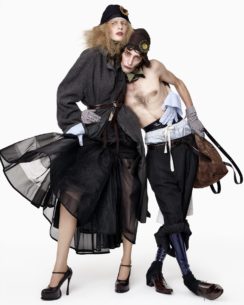
The premise is a seduction in reverse. Every piece begins as an archival Zara garment, a prototype, a lowly shirt or lace shift, and is re{form}ed through haute couture technique into something that remembers its former life only as a rumour. A shirt is graded up to three times its size and foil-printed until it passes for a leather coat, yet it keeps the lightness of poplin. A lace shift becomes a ruffled jabot. A jumper is worn back to front as a stole, its sleeves knotted in a bow at the spine. Fashion has always loved the moment a garment pretends to be something else. This is that moment, industrialised, then taken apart by hand.
His muses are Les Incroyables and Les Merveilleuses, the dandies and divas of post-Revolutionary France, who responded to a decade of guillotines by dressing as provocatively as the law allowed, in near-transparent muslin, with outrageous collars and a deliberate slouch. It is hard to think of a better patron saint for a moment of mass exhaustion. Survive the terror, then flaunt it. Galliano’s own early canon was built on them, so this is less a collaboration than a homecoming dressed in Zara’s labels.
The Flix is the collection’s most erotic idea, though no one says so. Named after flick books, it stacks sheer layers (a net dress with faux fur collar, cuffs and hem, gowns laid over gowns) so that a “coat” exists only as an optical event. The wearer swaps the layers beneath and changes the image. Nothing is quite covered, nothing quite revealed; the body becomes an animation running at the speed of a glance. It is a very French theory of nudity, which holds that suggestion is more indecent than fact.
Deep Pockets is the quietest and cleverest. By pulling the pockets back, forward or up, Galliano gives tailoring a posture: a lounge, a swagger, a hand thrust somewhere it shouldn’t be. A jacket acquires a lived-in character before the wearer has lived in it. Body language, cut into cloth.
Elsewhere the vocabulary grows playful: Wrapture, Pinch-to-Zoom, La Mouche Volant (the eighteenth-century fly embroidery, now three-dimensional and airborne), a Floating Bra cut from a slip dress with strands trailing down the back, and sans-culotte breeches spliced from trousers and shorts. The palette moves from gentleman’s black, navy and burgundy, through the olive and khaki of the garden, to the orchid pink, turquoise and acid green of film noir, as though the collection were slowly losing its inhibitions.
The accessories are where the wit turns political. The Tri-Chic, a reversible sack bag worn three ways, takes the bin-liner and elevates it to handbag, with a wink at tri sélectif, France’s waste sorting. Rubbish becomes glamour; the pun is the point. Add winklepickers, creased naval boots, T-straps with a whiff of the boudoir, opera gloves layered as a Flix effect, and hats made with Stephen Jones, and you have a wardrobe that is quite openly in on the joke.





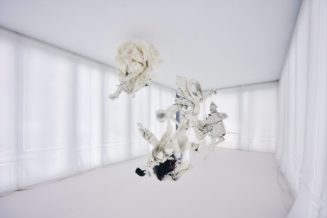
The real subject is memory. Zara’s archive is the world’s most wearable collective unconscious: the cardigan, the shirt, the trench we have all owned and forgotten. Galliano’s gesture says that nothing in this system is disposable if the right hands refuse to discard it. Whether a mass retailer can truly host that argument is another matter. A genderless, couture-built, small-batch idea that is also sold at scale is a contradiction. But fashion, like desire, has always been at its best when it holds one.
