



Dear Shaded Viewers,
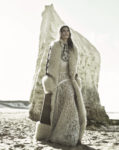
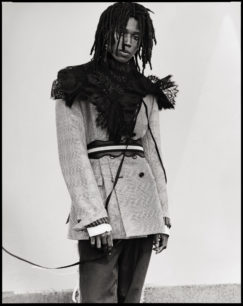
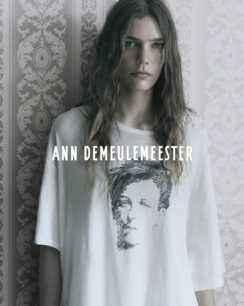
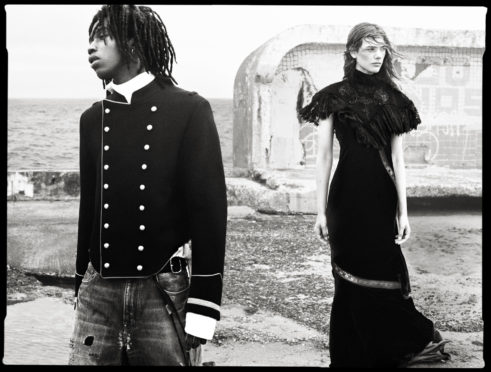
There’s a particular kind of light that only exists in seaside towns in the off-season — flat, generous, a little melancholic even at its brightest — and Ann Demeulemeester’s Autumn-Winter 2026 campaign is built entirely out of it. Shot by Nikolai von Bismarck in Margate, under Stefano Gallici’s direction as creative director, the story follows two young figures moving through town with the loose-limbed certainty of animals who’ve never once doubted where they’re going, even when they clearly have nowhere to be.
Antelopes, the release calls them, and it’s the right word. Not models posed against a backdrop but bodies in motion — striding past fishermen, old houses, empty streets, the sea they never quite turn to look at. That refusal to look at the water is the whole picture, in a way: this is a campaign about presence without engagement, about being somewhere fully while your attention is somewhere else entirely. A former love. A summer already spent. A winter that hasn’t happened yet. Time, as the text puts it, stopped somewhere between seasons — and Gallici seems to have built the entire campaign to hold that suspension rather than resolve it.
The clothes behave the same way the story does. A black velvet dress, its tail caught by the wind — the single most cinematic image in the set. A loose shirt open at the neck, unbothered. A silk scarf, a ribbon, a distressed T-shirt: not accessories so much as evidence, small fragments snagged between body and breeze, like things picked up along the way rather than dressed for. It’s tailoring and undoing at once, which is the oldest Demeulemeester sentence there is — sharp construction worn like it’s already coming apart — spoken here in a new accent.
What makes the campaign feel like a real continuation of the house rather than a moodboard exercise is the cast around it: Elodie David’s styling, Ben Grimes’ casting, Jorge Higgins directing the film with Oli Burslem’s “Suns” running underneath. Everyone in service of one idea — that the most romantic thing a picture can do is refuse to explain itself. Blank stares. Distant gazes. Faces that give nothing away because they’re not required to give anything away. It’s a campaign that trusts its audience to sit in ambiguity, which is precisely the trust Ann Demeulemeester has asked of its audience since 1985.
Stefano Gallici: A Signature Written in Two Keys
Every creative director inherits a language. Fewer of them are trusted to keep speaking it in their own voice, and it’s this — not the appointment itself — that makes Stefano Gallici’s tenure at Ann Demeulemeester worth paying attention to.
He was born in 1996 in Teor, a small town in the province of Udine, and split his adolescence between that burg and Venice — a geography that already contains the tension his work would later run on: the provincial and the cosmopolitan, the quiet and the loud. What pulled him toward fashion wasn’t fashion at all. It was punk rock, indie, garage — the aesthetics of sound before the aesthetics of cloth — and he followed that thread until it led him, almost logically, to a seamstress who taught him to sew simply so he could dress according to fantasies he hadn’t yet found a name for. That’s a telling origin story: not ambition, but appetite. He wanted to build the clothes his imagination was already wearing.
In 2016 he enrolled at IUAV University in Venice, a school shaped by Maria Luisa Frisa and Mario Lupano’s insistence that fashion be treated as both technical discipline and cultural text — a dual education that shows up in Gallici’s own work now, which is never only about the cut. Nine months with Haider Ackermann in 2017, shuttling between Paris and Antwerp, sharpened the technical hand further before he returned to Venice to graduate in 2018. Milan came next, and with it a run at Antonioli Group — the retail and cultural force that would go on to acquire Ann Demeulemeester in 2020, the same year Gallici joined the house. Three years later, in 2023, he was named creative director.
What’s notable about his version of Demeulemeester is that it doesn’t read as reverence and it doesn’t read as rupture. It reads as inheritance handled by someone who actually understands what he was given — the house’s founding grammar of contrast, tailoring against fluidity, masculinity against romance, darkness against light — now inflected with Gallici’s own musical instinct, his punk-and-garage sense of what a body does when it stops performing and starts just moving. The Margate campaign is the clearest statement of that inheritance yet: two figures who could be teenagers from any Antwerp Six-era Demeulemeester show, dropped into a British seaside town, dressed like the story hasn’t ended, just paused.
It’s early in his directorship, but the signature is already legible — vibrant, individual, and unmistakably built on top of Ann’s own foundations rather than instead of them.
Later,
Diane
