
Dear Shaded Viewers,
The archive of fashion is full of what survived. But what about everything that didn’t?
There are museums for fashion, archives for fashion, foundations for fashion, libraries for fashion. There are rooms filled with dresses preserved at carefully controlled temperatures, shoes placed beneath glass, sketches stored in acid-free boxes and photographs catalogued by date, designer and collection.
Fashion has become remarkably good at remembering itself.
But there is another fashion history, one that is harder to see.
It is made of collections that disappeared, garments that were never completed, samples that were never produced, designers whose names slipped out of the conversation, shows that were cancelled, ideas that arrived too early and objects that were simply thrown away.
It is the history of everything that almost happened.
Perhaps this is the collection we should be looking at now.
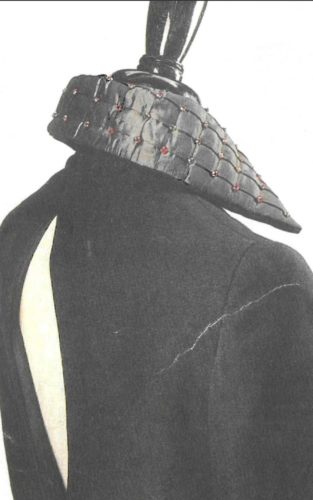
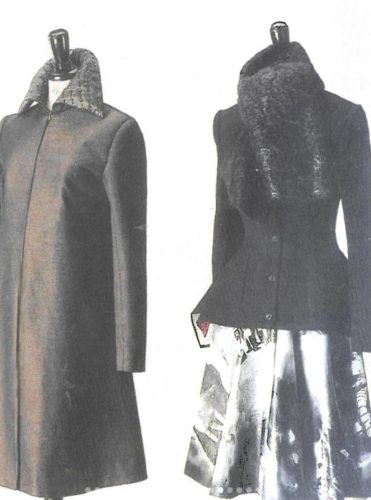
Consider Alexander McQueen’s Autumn/Winter 1993 collection, Taxi Driver, created after his graduation from CSM — his first official collection – and was exhibited at the Ritz in London rather than presented as a conventional runway show. The collection introduced, among other things, his radically low-slung bumster trousers. Yet the clothes themselves did not survive as a complete collection. Contemporary documentation and later accounts record that the garments were accidentally lost after the exhibition. What remains are photographs, descriptions and other traces of the collection.
There is something almost unsettling about this.
One of the most important early collections of one of fashion’s most important designers exists, historically, in a peculiar state: we know it happened, but we cannot walk into an archive and encounter the collection itself.
What does it mean to remember clothes that no longer exist?
Perhaps the answer is that fashion history has always been less solid than we imagine.
We like to think of the museum as the place where fashion becomes permanent. The garment enters a collection, receives a number, is photographed, conserved and eventually displayed. It moves from the temporary world of fashion into the supposedly permanent world of history.
But permanence is selective.
A museum cannot preserve everything. An archive cannot collect everything. Someone has to decide what deserves to survive.
And fashion itself is particularly vulnerable to disappearance. Clothes are made to be worn, altered, stained, repaired, cut apart, sold, discarded and replaced. Their fragility is not an accident. It is part of their nature.
This is precisely what Fashion Unraveled, an exhibition at The Museum at FIT in 2018, attempted to address.
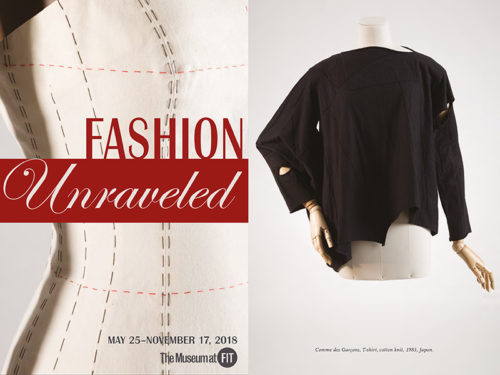
Instead of presenting only pristine garments representing a designer, period or aesthetic, the exhibition focused on imperfection, incompletion, alteration, repurposing and wear. It included unfinished garments and samples, arguing that these objects can reveal something about the process of making fashion that a finished garment cannot.
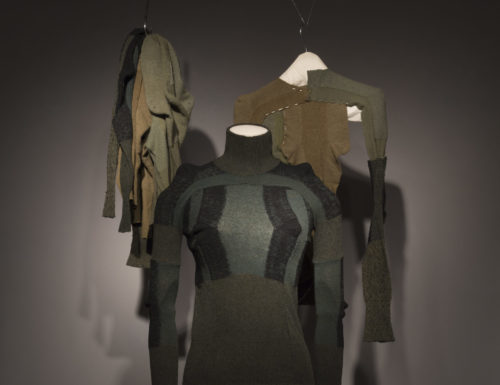
An unfinished garment is particularly interesting because it occupies an uncomfortable position.
It is not quite a product.
It is not quite an artwork.
It may not even have been intended to be seen.
It is evidence of a decision that was still being made.
A finished garment tells us what happened at the end of a process. An unfinished garment allows us to see the process before the decision became final.
Perhaps the unfinished object is therefore closer to the designer’s thought.
This changes the way we might understand the archive.
Instead of seeing it as a collection of conclusions, we might see it as a collection of questions.
The sketch before the garment.
The sample before the collection.
The fitting before the final silhouette.
The mistake before it became an aesthetic.
The rejected idea before someone else eventually made it fashionable.
Fashion has always had a complicated relationship with incompletion. Martin Margiela built an entire language around exposing the construction of clothes, reversing garments, showing linings, using unfinished edges and transforming discarded materials. His work repeatedly questioned the boundary between the finished garment and the evidence of its making.
It is therefore fitting that a 2023–24 exhibition, Margiela: In the Void, was constructed partly around absence itself: missing pieces from archival looks became what the exhibition described as “voids,” gaps where an object that would complete the look was no longer present. Artists and designers were invited to respond to these absences.
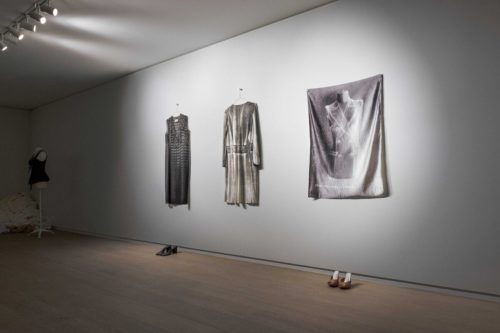
The missing garment becomes part of the exhibition.
The absence becomes an object.
This may be one of the most interesting things a fashion archive can do: not simply show us what it has, but make us conscious of what it doesn’t have.
Because every archive contains ghosts.
Some are physical.
Others are people.
A designer without an archive may eventually become a designer who never existed, at least as far as the official history is concerned.
This is where the archive becomes more than storage.
It becomes an instrument of cultural memory.
What survives is easier to remember.
What is photographed is easier to reproduce.
What is catalogued is easier to teach.
What enters an institution becomes easier to call important.
The archive therefore does not simply preserve fashion history.
It helps produce it.
There is an irony here. Fashion is an industry obsessed with the new, yet its cultural value increasingly depends on its ability to preserve the past. The archive has become one of fashion’s great forms of legitimacy.
Designers are given retrospectives.
Old collections are rediscovered.
Vintage garments are authenticated.
Lost images become valuable.
The past becomes a resource.
But what happens to the past that cannot be authenticated because almost nothing remains?
What happens to the collection represented by one photograph?
The designer whose only surviving evidence is an invitation?
The garment whose only trace is a sketch?
The fashion show remembered by the people who attended it but never filmed?
These are not insignificant questions.
They point to a fundamental problem with the way fashion history is constructed.
We tend to confuse survival with importance.
But survival is partly an accident.
A garment can survive because someone loved it.
Because someone had enough money to store it.
Because a designer had an institution behind them.
Because a collector understood its significance.
Because a museum acquired it.
Because a photograph was taken at the right moment.
And another garment can disappear because none of those things happened.
There is something particularly moving about this when we consider the ordinary clothes that make up most people’s fashion histories.
The dress worn every day until it fell apart.
The jacket altered three times before being given away.
The pair of shoes worn until the soles disappeared.
The garment inherited from a mother, then cut apart by a daughter.
These clothes may have had enormous emotional value while having almost no institutional value.
Museums have traditionally privileged condition. Yet a worn garment can tell us more about a life than a pristine one.
A perfect dress tells us what it looked like.
A damaged dress can tell us what happened to it.
This is why the work of preserving fashion is increasingly becoming a question not only of objects, but of biographies.
Who wore it?
Why was it altered?
What happened to it?
Why was it kept?
Why did somebody throw it away?
What does the damage tell us?
The most interesting archive may not be the one containing the most perfect garments.
It may be the one capable of reading the imperfections.
Today, that history may be becoming even harder to preserve.
Collections are announced through social media. Campaigns can circulate further than the garments they advertise. Designers communicate directly through digital platforms. Images can be edited, deleted, reposted and transformed without leaving a stable physical trace.
What happens when the image survives but the object does not?
What happens when the image itself disappears?
A website closes.
An Instagram account is deleted.
A designer’s archive sits on an obsolete hard drive.
A digital file becomes unreadable.
A garment exists only in a photograph of a photograph.
The paradox is extraordinary: we have more documentation of fashion than ever before, yet we may also be creating a fashion history that is increasingly difficult to preserve.
Clothes were never meant to last forever. Their power comes partly from their temporary nature. A garment moves through a body, a room, a city, a decade. It is altered by use. It fades. It disappears.
Fashion is an art form that has always been comfortable with death.
The season ends.
The silhouette disappears.
The collection is replaced.
The body changes.
The garment is stored.
Then, sometimes, decades later, someone opens a box and discovers something that almost disappeared.
That is when fashion history becomes interesting again.
Not when everything has been preserved, but when something has survived against the odds.
Perhaps, then, we need to expand our definition of the archive.
Not only the things that happened, but the things that almost happened.
Not only the finished garment, but the unfinished one.
Not only the famous designer, but the forgotten one.
Not only the collection, but the abandoned possibility of a collection.
Fashion history is usually written in the past tense.
But perhaps its most fascinating objects belong to the conditional:
This could have happened.
This was supposed to happen.
This almost existed.
This was lost.
And somewhere between the archive and the void, between the garment and its absence, is another history of fashion waiting to be remembered.
Lately,
Eva
