
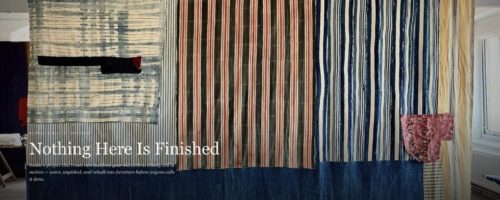
Styling Katie Shillingford · Photography Ben Toms
Dear Shaded Viewers,
There is a moment in the studio, before any of this is photographed, when a length of two-hundred-year-old ticking stripe or a torn square of French lace stops behaving like a textile and starts behaving like something closer to a body. That handoff — cloth into flesh, flesh into furniture — is the whole premise of IN/FORM, the latest project from the London studio Clarke & Reilly. It is built to resist the arc most design stories tell, in which raw material becomes finished object. Here, nothing gets to finish.
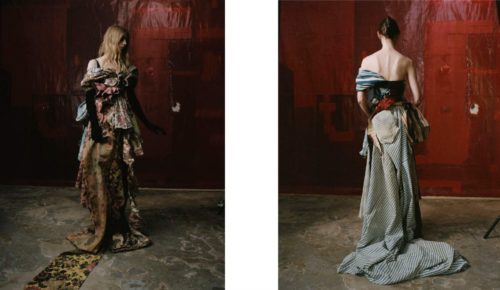
The fragments they work with arrive already marked: patched, sun-bleached, mended by hands long gone, carrying the kind of wear no mill can fake. Clarke & Reilly don’t treat that history as a flaw to design around. They treat it as the point — textile as lived time, a material forever moving between what it was and what it might become next, rather than settling into either.
“Antique fragments, marked by use, repair, and skill passed from hand to hand, neither discarded nor complete, exist in continuous life.”
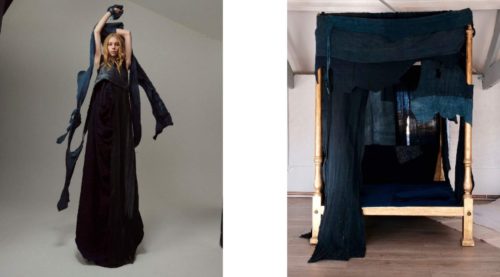
The same indigo cloth, twice: cinched around a body, then raised as a canopy over an antique four-poster bed.
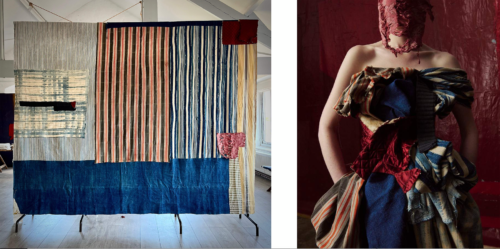
To test how far that idea could stretch, Clarke & Reilly handed the archive to stylist Katie Shillingford and asked her to work it two ways at once, as material and as garment. Nothing was cut or sewn to fit; everything is wrapped, knotted, held. The results, photographed by Ben Toms against a bruised red backdrop — its surface painted over half-legible fragments of text by the critic Susannah Frankel — don’t read as clothing exactly. One model disappears under a corset built from a striped train and a wrecked scrap of rose silk. Another stands wound in nothing more than two clashing lengths of indigo, her expression flat, almost bored by her own transformation.
Then comes the part most fashion stories skip. Once Toms has what he needs, the garments come apart. Clarke & Reilly unpick every wrap and knot back into its original fragments and start again — this time building furniture, not clothes. A Georgian armchair is bound entirely in antique lace until its outline reads less like an object you’d sit in and more like a photographic negative of one. A wrought-iron chandelier is wrapped rather than restored, its arms gone the same chalky grey as the drop cloth beneath it. Practical function is beside the point; what matters is that the material keeps moving.

The furniture belongs to a separate maker, David Grocott, whose contribution is less about designing than about listening: winding, binding and threading textile around forms that already exist, then stopping before the material resolves into anything you could call finished. It’s a deliberately awkward handoff between three practices — styling, photography, object-making — each working the same scraps of cloth toward a different, unresolved end.

What IN/FORM ultimately argues for is a kind of craftsmanship that never gets to claim an ending — cloth handed from body to form to function and back again, gathering more history at every stage instead of erasing it. It is less a finished collection than a working proof: that the most interesting thing you can do with a damaged, centuries-old textile might be to simply keep it moving.

Thursday 10th – Sunday 13th during store hours.
Later,
Diane
