


Dear Shaded Viewers,
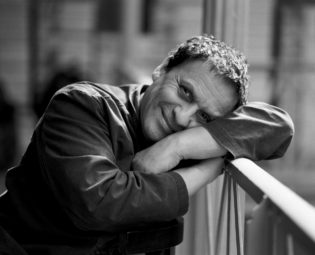
There is a particular kind of vindication in watching a museum catch up to a designer who never once tried to keep pace with anyone. This November, the Legion of Honor in San Francisco opens Sculpting Fashion, the first major American retrospective of Azzedine Alaïa — a man who spent the better part of two decades refusing to show on schedule, refusing to be hurried, refusing, essentially, to be fashion in the way the industry insisted fashion had to behave.
It is worth sitting with that refusal, because it is the key to everything the exhibition promises to unlock. Alaïa trained as a sculptor in Tunis before he ever touched a bolt of jersey, and it shows in the most literal sense: he understood the body the way a sculptor understands mass and weight, not the way a tailor understands a pattern. When he finally released his first ready-to-wear collection in 1980, after years spent quietly dressing clients and Parisian entertainers out of his own apartment, what he offered was already fully formed — a vocabulary of curve and compression that had nothing to do with the boxy, oversized silhouettes dominating runways at the time. He was not reacting to fashion. He was working from an entirely different set of instructions.
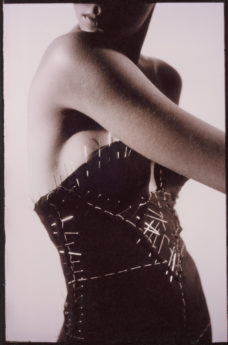
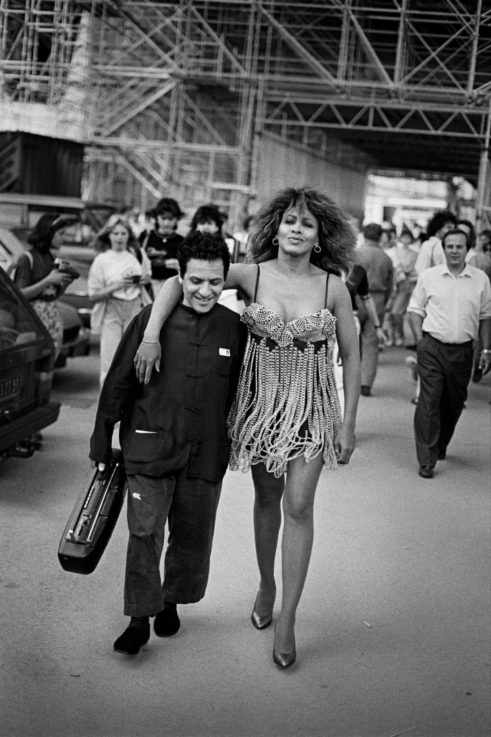
By 1987 he had stopped showing on the official calendar altogether, presenting collections only when they were finished — an act that reads today as almost unthinkable, in an industry now organized around content velocity rather than craft. He made the garments himself: pattern, cut, fitting, pressing. The bandage dress, the second-skin silhouettes that would later find their way onto Tina Turner and Grace Jones and, decades on, Rihanna, were not marketing devices. They were the result of a man who treated dressmaking as an ongoing research project, one he was in no rush to conclude.
There is something quietly pointed, too, in the exhibition’s framing of Alaïa’s body-conscious designs as an instrument of autonomy rather than spectacle. It is easy, at a distance, to flatten his work into “sexy dresses” — but the more interesting reading, the one the curators seem intent on making, is that Alaïa’s cut gave women a way to occupy their own shape on their own terms, at a moment when that was still a genuinely radical proposition. The exhibition’s inclusion of his personal collection of historical couture — the Diors, the Balenciagas he studied and absorbed before he had a vision of his own — makes the case that his sculptural approach didn’t arrive from nowhere. It was earned, garment by garment, through years of close, almost devotional study of how other masters had solved the same problem.
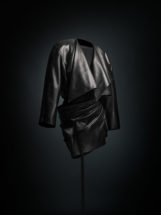
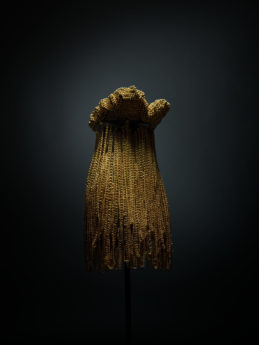
That the show lands at the Legion of Honor rather than a fashion-specific institution feels apt rather than incidental. Alaïa’s own foundation, the collection he built at 18 Rue de la Verrerie in Paris, has always insisted on placing fashion in conversation with sculpture, architecture, and art history — never treating it as a lesser discipline requiring justification. Installing eighty garments across the Legion’s European galleries, in dialogue with the museum’s permanent collection, extends that argument onto new ground. It is a way of saying, without saying it outright, that a bandage dress belongs in the same room as a Rodin.
Nearly a decade after his death, the timing of a first US retrospective raises its own quiet question — why now, and why here. Part of the answer may simply be that American institutions have historically been slower to grant couture the same seriousness Paris affords it as a matter of course. But there’s also something fitting about San Francisco specifically: a city Alaïa held real affection for, one that in 2005 named a day in his honor alongside his great friend and collaborator Carla Sozzani. The retrospective isn’t just an import of Parisian prestige — it closes a loop that was already, in some small way, open.
What the exhibition ultimately offers isn’t nostalgia. It’s a chance to see, in one room, the full arc of a designer who understood that craftsmanship and defiance were not opposing forces but the same gesture, repeated for forty years. Alaïa built a body of work — quite literally — that never needed the fashion calendar’s permission to matter. The Legion of Honor is simply, belatedly, giving it the room to prove that.
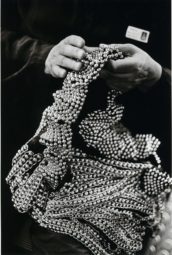
photo credits: Azzedine Alaïa (1935–2017), dress, Spring/Summer 1990 Haute Couture. Viscose, polyamide, and elastane. Courtesy of Fondation Azzedine Alaïa. Photograph © Andrea & Valentina, Azzedine Alaïa (1935–2017), dress, Spring/Summer 1986 Haute Couture, Acetate jersey. Modeled by Grace Jones (American, b. Jamaica, 1948) in the fashion show and worn to the Oscars de la Mode, hosted by the Fédération de la Haute Couture et de la Mode, Palais Garnier, Paris, October 23,1985. Courtesy of Fondation Azzedine Alaïa. Photograph © Andrea & Valentina, Azzedine Alaïa (1935–2017), ensemble: bolero, skirt, and top, Spring/Summer 1984 Ready-to-Wear. Bolero and skirt: lambskin leather; Top: viscose-polyamide blend jersey. Courtesy of Fondation Azzedine Alaïa. Photograph © Andrea & Valentina, Azzedine Alaïa (1935–2017), dress, Spring/Summer 1989 Haute Couture. Silk organza and gold-tone steel beads. Worn by Tina Turner (American, 1939–2023) during a photo shoot with Peter Lindbergh, Paris, 1989. Courtesy of Fondation Azzedine Alaïa. Photograph © Andrea & Valentina, Veronica Webb for Azzedine Alaïa, bustier dress with pins, 1987. © Jean-Baptiste Mondino., Azzedine Alaïa adjusting dress beads, Paris, 1989. Photograph by Peter Lindbergh. Courtesy of the Peter Lindbergh Foundation, Paris., Azzedine Alaïa and Tina Turner, Paris, 1989. Photograph by Peter Lindbergh. Courtesy of the Peter Lindbergh Foundation, Paris.
Later,
Diane
Azzedine Alaïa: Sculpting Fashion opens November 21, 2026, and runs through April 11, 2027, at the Legion of Honor, San Francisco.
