
Dear Shaded Viewers,
I first came across Saul Zanolari’s work through portraits he made of Diane Pernet, and Alberto Vargas. Looking closer, I realized the circle extended. Familiar faces kept appearing. Now, I find myself part of his own kind of Pandora’s box.
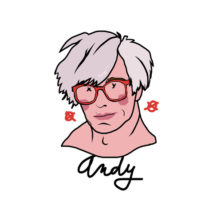




For more than a decade, Saul has worked through repetition. Drawing, engraving, returning to the face again and again. Over time, the image begins to change. In his current EGO SYSTEM, identity shifts, builds in layers, sometimes appears masked. Faces are still there, but something in them feels different. What you see holds both a person and a structure.
The concept of ego today feels flatter. More surface than depth. Easy to read, harder to question. It can feel like a form of protection, or something closer to disappearance. This tension runs quietly through Saul’s work.
A few weeks ahead of the EGO SYSTEM private show during Milan Design Week, I dive into Saul’s process and thinking. The project unfolds as a kind of digital cadavre exquis; collectible, evolving, and never quite the same twice.
Pedro: What was your initial inspiration or intention when you first created your original series, and how have you seen the project evolve or grow over time?
Saul: It started with a crisis. Two years where everything stopped — creatively, existentially. Before that, my work was hyper-realistic, obsessively detailed, dense. I was building worlds with maximum complexity, layering everything. And then I couldn’t anymore. Not as a choice. As a collapse.
What came out of that silence was the opposite of what came before. I took an old portrait — Anna Wintour, someone I had already painted years earlier — and started removing. Eyes, details, complexity — everything that wasn’t essential. Not as an aesthetic decision. More like someone who has lost everything and discovers that what remains is actually enough. Going back to that same face and stripping it down felt right: not a new subject, but a new relationship with what I already knew. That gesture was me rebuilding myself from scratch, and XXY Portraits was the language that emerged from it.
From there the work grew through its own logic. The name disappeared. The ego expanded beyond the individual. One portrait generated another. What started as a personal reinvention became a generative system — something that keeps producing beyond intention. But the origin is always that moment of necessary emptiness. You don’t find a new language by looking for it. You find it when you have no choice but to start over.
P: You describe today’s ego as more “flat” or surface-level. How do you explore this idea in your portraits and creative process?
S: The flatness is structural, not aesthetic. Eyes are replaced by chromosomal notation — XX or XY. Not absence, but classification. Biology reduced to a sign. Identity reduced to system. What disappears is the possibility of exchange. Without eyes there is no mirror, no dialogue — only surface. The viewer activates the work precisely because there is nothing looking back.
The cheeks operate differently. They expand, redden, swell outward — not decoratively, but as involuntary signals. The ego inflates as the individual contracts. Visibility increases as depth disappears. This is the paradox the portraits hold: more ego to survive means less person remaining. The work doesn’t comment on this condition. It gives it a form precise enough to be measured.
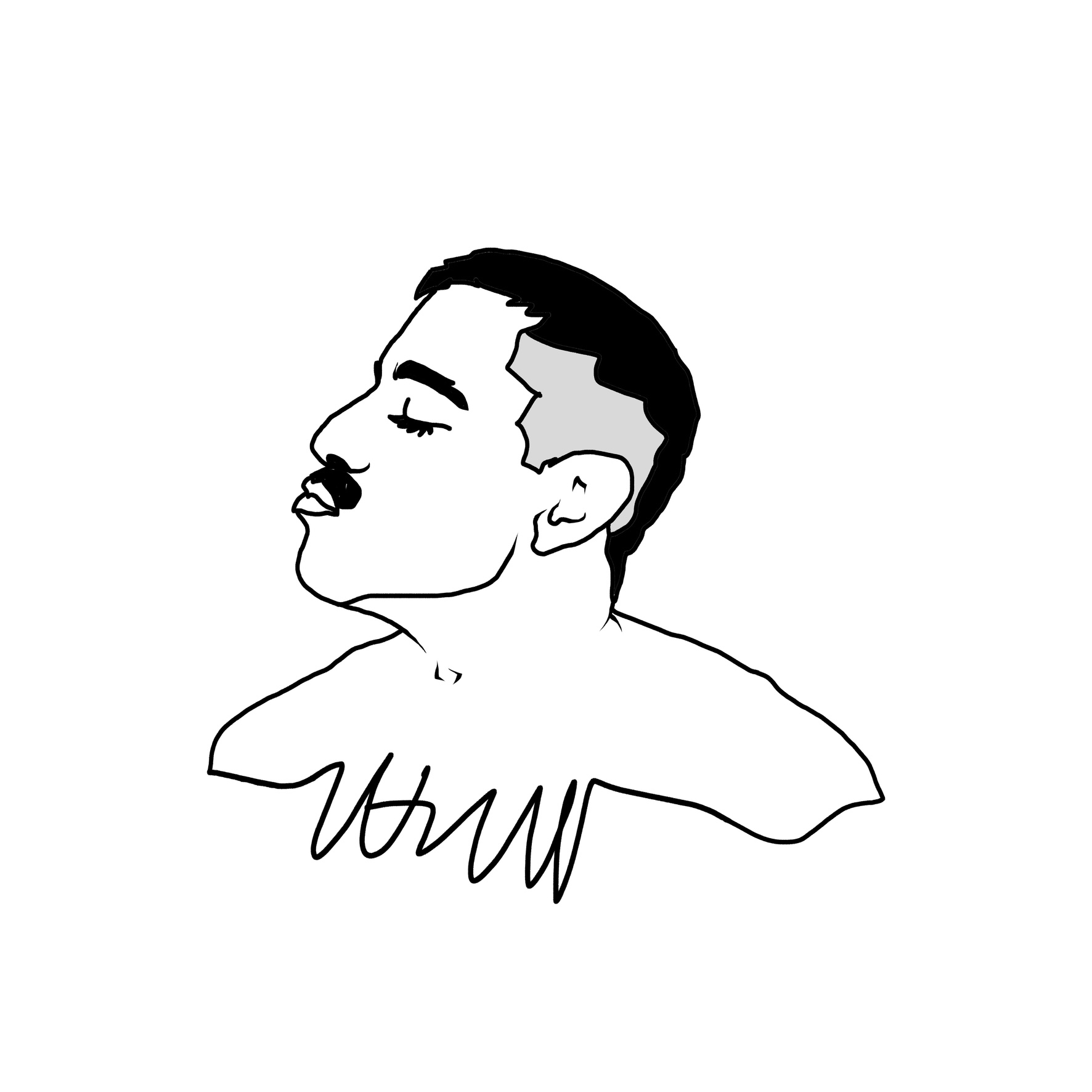
Self-portrait, Saul Zanolari.
P: Your work involves a lot of repetition and layering. What does this process allow you to discover about identity?
S: Repetition is not a style choice. It’s a research method. Each portrait uses the same grammar — lines, symbols, chromosomal markers, expanding cheeks. The grammar survives from work to work. What changes is the configuration. Across hundreds of iterations, identity reveals itself not as something an individual possesses, but as something a system produces. The portrait stops being a record of who someone is and becomes an instance of how ego manifests.
Each portrait also carries an astrological code — zodiacal symbols that mark not the psychology of the subject, but the moment the portrait exists. Not destiny, not personality. Coordinates. The sky at the time of making becomes part of the work’s structure, a temporal layer embedded in every piece. Identity, in this system, is never just the person. It is the person at a specific moment in time, under a specific configuration.
Layering — across generations, across subjects — produces something unexpected. In Gen1, two parents generate a third portrait that resembles neither, or both, in ways that couldn’t be predicted. The system doesn’t represent. It produces. And what it produces keeps exceeding the intention behind it. That gap between what was planned and what emerges is where the work actually lives.



EGO SYSTEM is organized as a generative system with distinct but connected layers:
Gen0 is the founding matrix. It contains three types: XXY Portraits — portraits of real, named people, identity still anchored to biography and recognition; Ego Masks — portraits where the name has been removed, the subject exists only as ego, unnamed and unanchored, a byproduct of the matrix rather than its subject; and Masks — the wearable version of Ego Masks and select XXY Portraits, where the perspective inverts entirely. The face is no longer something to look at. It becomes something to look through. Gen1 is Gen0 reproducing itself. Two existing portraits — two subjects from the matrix — are manually combined to produce a third. Not a blend, not a copy. An offspring, with its own visual genetics: dominant and recessive traits, chromatic drift, formal inheritance. The lineage is encoded in the title.



EGO SYSTEM will be presented in a private show from April 23–24 in Milano, during Milan Design Week, in a space in Città Studi. By invitation only.
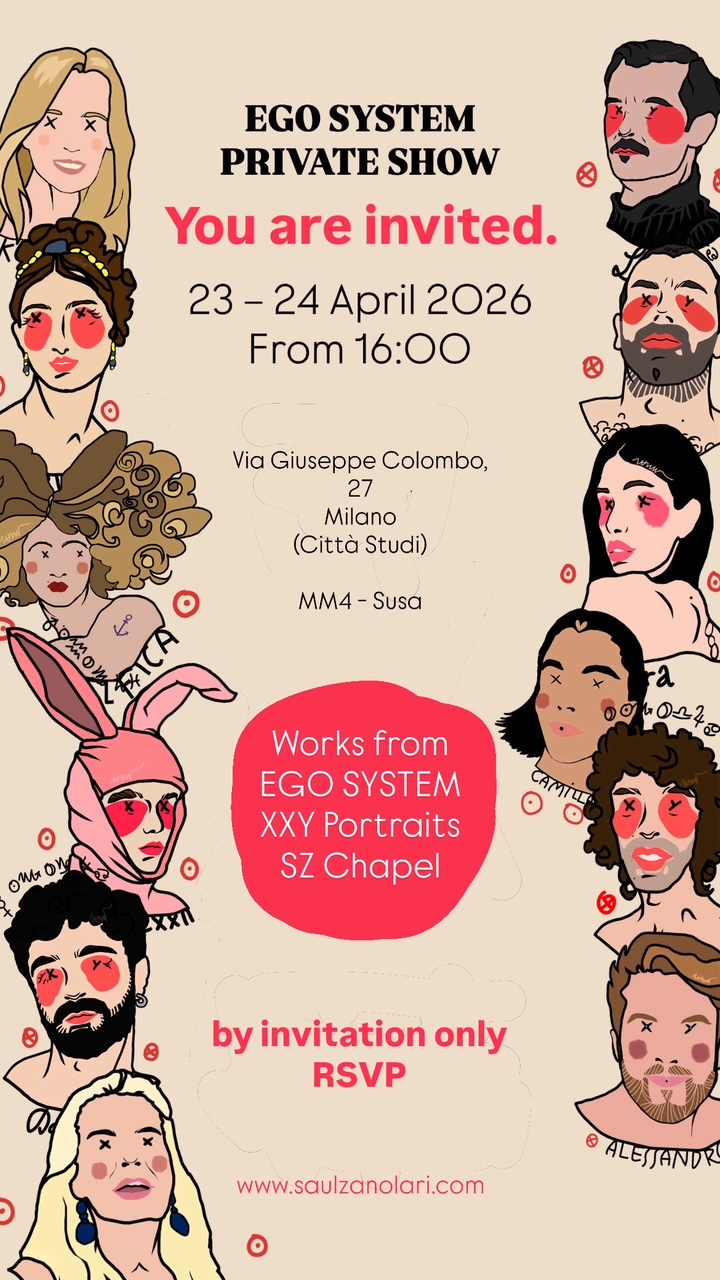
The presentation brings together works from different moments of the project. Large painted pieces, previously shown at Joyce Gallery in Shanghai and Hong Kong, and at Kir Royale Gallery in Valencia, are shown alongside smaller works on wood. Each one reveals a more immediate and ongoing layer of the practice.

Happy to be part of the EGO family. See you in Milano. RSVP: https://saulzanolari.com/
Yours digitally,
Pedro
