
















Dear Shaded Viewers,
Situationist’s fall 2026 show read as a lucid, hard‑won second act: a decade‑in milestone underwritten, at last, by capital, but still anchored in the raw, political edge that made the Georgian label matter in the first place.
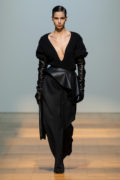
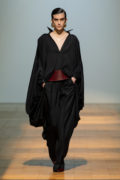
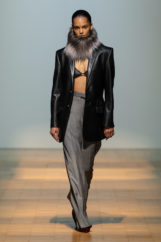
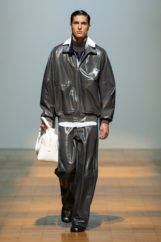
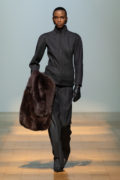
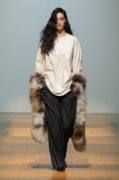
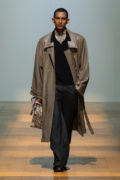
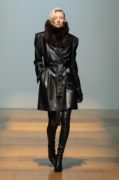
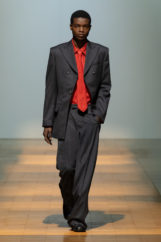
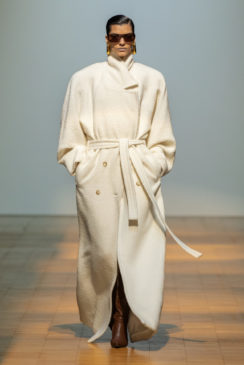
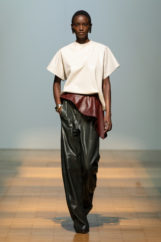
Presented in Paris as the brand celebrates 10 years, the collection tightened Situationist’s familiar vocabulary of sharp tailoring, sculptural leather and protective outerwear rather than blowing it up for the occasion. Silhouettes stayed close to the body but carried a sense of armour, with dense wool, leather and faux fur worked into elongated coats, double‑collar suiting and high necklines that framed the head almost like a protest placard. Earlier seasons’ language of resistance was still present, but here it felt less improvised and more orchestrated, as if the designer finally had the means to match his ambition.
Color moved between deep reds, baby blues and dark, neutral tones, a palette that nodded to both night‑time Tbilisi and the cooler light of Paris streets. The casting — a mix of professionals and those who felt like long‑standing members of the Situationist community — reinforced that tension between polish and intimacy, turning the runway into a moving cross‑section of the world the brand speaks to.
The subtext of the evening was the new money behind the house. Situationist secured a private investment at the end of 2025, a deal that has allowed Irakli Rusadze to overhaul the business, fund this season’s on‑calendar show, and plan for e‑commerce, marketing and new categories like bags and shoes. It is precisely the kind of targeted capital injection that recent industry analysis has framed as the most viable route for independent labels: not mega‑buyouts, but strategic backing for brands with a strong narrative and clearly defined codes.
That context matters, because this collection felt like a proof‑of‑concept for investors as much as a love letter to the brand’s followers. The clothes demonstrated scalability without sanding down the edges: signatures were reiterated with more discipline, proportions were cleaner, and there was a visible focus on building a coherent wardrobe rather than a season of isolated “moments.” In a market where deal‑makers are increasingly wary of pure trend play, Situationist presented itself as a long‑game proposition, with a story rooted in place and politics — and now, with the infrastructure to grow.
To understand why this “take two” carries such weight, you have to return to Rusadze’s beginnings. Born in Tbilisi in 1991, he is a self‑taught designer who learned construction from traditional Georgian masters and entered the industry at 15, long before Situationist formally launched around 2015–2016. His work has consistently used pattern‑cutting and tailoring to push back against reductive “post‑Soviet” clichés, folding contemporary Georgian social realities into a visual language of strict coats, twisted dresses and gender‑fluid silhouettes.
Over the last decade, that vocabulary has dressed everyone from local communities and friends of the brand to global celebrities, and taken Situationist from Tbilisi to Browns to the official Paris calendar. Yet the label has always read as fiercely local at heart, maintaining collaborations with Georgian artists and nightlife while treating the runway as a platform for resilience in the face of the country’s political turbulence. This new phase does not erase that; instead, last night’s show suggested that the designer is interested in exporting a Georgian point of view without diluting it — a more structured, better funded continuation of the same story.
What emerged was a portrait of a house at an inflection point: no longer an under‑the‑radar cult name, but not yet absorbed into the global luxury machine it critiques. The influx of capital is already visible in the production values and in the clarity of the collection’s message, but the show’s power lay in how carefully Rusadze calibrated that polish against the urgency that made Situationist compelling in the first place.
If this is Situationist’s second chapter, it opens with a statement of control rather than spectacle: a tightened, confident reassertion of the brand’s core grammar — Georgian, political, urban, precise — delivered on a Paris stage that now feels fully earned.
Later,
Diane