


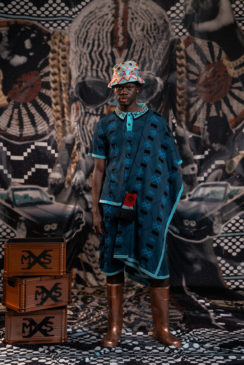

Always a moment of rejoicing, the return of Laduma Ngxokolo to Paris Fashion Week brings a distinctive energy to the schedule, a cultural resonance extending beyond the runway. Under his label MaXhosa Africa, the South African designer unveiled “Siyi-Kulture,” a collection translating his long-standing mission of positioning African heritage as an active contributor to global fashion and creative dialogue. Now presenting his fifth consecutive season on the official calendar accredited by the Fédération de la Haute Couture et de la Mode, Ngxokolo remains the only Africa-based brand on the schedule.
High-frequency beats of Amapiano had the audience subtly—or not so subtly—shaking their shoulders, proving that even the most composed fashion crowd can’t resist South Africa’s fastest-growing music export. Its global rise proved that local cultural waves no longer stay local. On the runway, the silhouettes moved with the same magnetic energy: coats and knit dresses flashed bold, graphic patterns, colorful knitwear sets, and outerwear brought sharper, modern lines. Ngxokolo’s work has always treated South African cultural codes—particularly Xhosa knit traditions. This season, he expanded the conversation, emphasizing references across the country’s diverse cultural landscape: from Xhosa to Zulu, Pedi to Sotho – a rhythmic and sacred conversation between identities. Ngxokolo channels the spirit of warriors, dancers, and storytellers into modern silhouettes, warriors, dancers, and storytellers layering folklore.
At the heart of MaXhosa is a deep commitment to craft and community. The designer operates with a network of local artisans whose handmade knitwear maintains technical craftwork and cultural symbolism. Each pattern references traditional principles – a heritage designed for everyday life. A mad crush for the velvet tracksuit embellished with strass detailing, a mandatory flamboyant touch. While referenced as a streetwear code, the material choice and embellishment elevated the piece into something more ritualistic and celebratory. The collection reflects a broader philosophy: traditional aesthetics should not remain stationary or confined to ceremonial use. As Laduma Ngxokolo reminds us, “You can’t invent culture—you can only evolve it.” Bold, alive, Africa’s heartbeat pulses as a movement.
