














Dear Shaded Viewers,
Andreas Kronthaler’s new Andreas Kronthaler for Vivienne Westwood collection doesn’t just “catch the rhythm”; it grabs it by the throat and drags the house into its most exhilarating post‑Vivienne era. This was the moment when grief, memory, and Westwood’s anarchic wit finally fused into a language entirely, confidently Andreas.
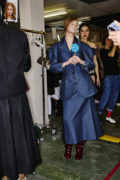
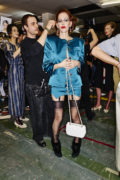
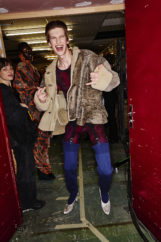
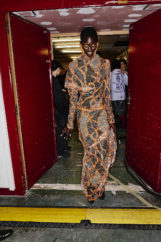
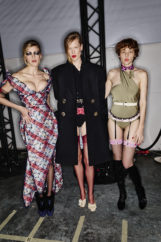
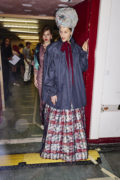
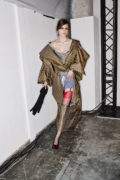
Vivienne’s phrase “Catch the Rhythm” sits at the top of the show note, but the rest is pure Kronthaler: Romy Schneider as patron saint of Austrian intensity, Danilo Donati’s Pasolini costumes as a template for baroque storytelling, and Chaucer’s lusty pilgrims as spiritual guides. Those touchstones came through in silhouettes that felt at once historic and brutally present—college blazers and dinner jackets in silk, shoulders double‑padded to cartoonish extremes, over narrow skirts and striped coats with the swagger of a costume that has lived several lives already. The collection is technically a winter one, yet it burned hot: smock dresses tied with ribbons, “Cupid” knitwear that clung like a crush, and outerwear that looked as if it had been pulled from some attic of collective memory and cut anew.
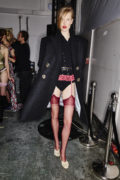
What made this feel like Andreas’s strongest outing since Vivienne died was the cohesion of his chaos. Fabrics with structure sat next to those with random colour mixes, deliberately “not coordinated,” yet every look locked into the next like a syncopated beat. Erotic underwear ran as a through‑line—garter belts, stockings, bras, even toys and “hard candy”—echoing Chaucer’s fascination with what lies under the respectable surface and Westwood’s own historic delight in visible lingerie. You could feel Romy Schneider’s vulnerability and volatility in the way a strict coat might fall open to reveal a slip that looked one sigh away from the bedroom.
And then there was the soundtrack, which turned a strong collection into a genuinely great show. Written and produced by Boy George and Kinky Roland, the music didn’t sit politely behind the clothes; it pushed them, pulled them, and occasionally dared them to keep up. Their long‑honed mix of club melancholy and camp glamour became a narrative in itself—beats swelling into moments of near‑hymnal release, basslines snarling under tender melodies, as if the 80s, 90s clubland and a Westwood fitting had all been spliced into one continuous track. No wonder the audience felt pinned to their seats yet ready to dance; the score gave the show a spine, a sense that each exit was a verse in a larger song about survival, desire, and letting fashion be fun again.
In the press note, Andreas closes with a direct address to his mother and to Vivienne: “You gave me so much and I’m trying to get used to the world without you… I will keep working.” On this runway, under this music, that promise finally looked fulfilled. This wasn’t a séance for Westwood’s ghost; it was a living, pulsing declaration that her house, in Andreas’s hands, is not done surprising us yet.
Later,
Diane
