

















Dear Shaded Viewers,
Yohji Yamamoto asked for something very simple tonight: no phones, no press notes, just eyes on the stage and ears tuned to the sound of cloth. In return, he delivered his most resonant collection in years, a reminder of how powerful fashion becomes when it is allowed to unfold in real time rather than on a screen.
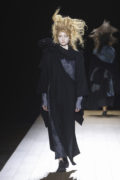
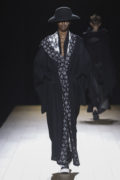
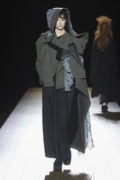
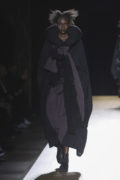
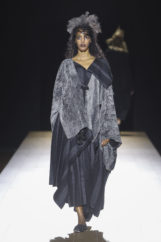
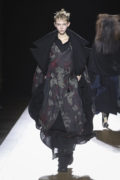
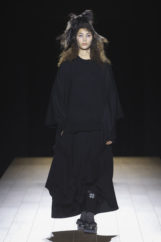
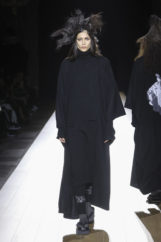
The show opened with long, dark silhouettes that seemed to float rather than walk, their volumes knotted and draped around the body with the assurance of a couturier who knows every centimeter of his own archive and still finds new ways to disturb it. Black coats fell in enveloping columns, slit just enough to reveal striped under‑layers that flashed like whispers at the hem; shawl collars blossomed into sculpted petals around the neck, framing faces in chiaroscuro. The effect was not monastic severity but a kind of tender protection, as if each look were a portable refuge against the outside world.
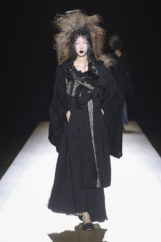
Hair and make‑up played directly into that tension between shelter and disquiet. Wild, back‑combed manes radiated outward like electric halos, hovering between storm cloud and saint, while faces stayed strangely bare, human, unretouched by obvious contour or gloss. At times the head became an entire landscape: explosive straw‑like textures, or ornate constructions of fans, cords and lacquered spikes perched above the draped kimono jackets and coats. Far from competing with the clothes, these headpieces completed them, extending the lines of the garments into the air and turning each silhouette into a moving sculpture.
As the collection progressed, Yamamoto allowed color and motif to seep into the darkness in measured, almost musical increments. Cranes in midnight blue and violet glided across skirts and wrapped panels, their long legs and beaks tracing the rhythm of the walk. Elsewhere, dense prints evoking screens, ukiyo‑e fragments or nocturnal cityscapes spilled over the front of black kimono coats, like memories half‑remembered and re‑stitched. These images never felt illustrative; they were swallowed by the drape, broken by seams and knots, becoming part of the garment’s architecture rather than simply sitting on its surface.
The construction itself was some of the most sensual Yamamoto has shown recently. Fabrics were layered so that a single turn of the body could pivot an entire look: a cape slipping off the shoulder to reveal a sliver of chalk‑stripe, a wrapped panel unrolling into a train, a scarf‑like piece looping around the neck and returning as a sash at the hip. There was romance here, but it was structural, embedded in the way the garments moved with the wearer rather than in any obvious decoration. Even the heavier, padded pieces—huge donut‑like collars, cocooning wraps—retained a surprising lightness, more embrace than armour.
What truly set the show apart, though, was tempo. Without the distraction of screens, the audience adjusted to Yamamoto time: slightly slower, more deliberate, calibrated to the swing of a sleeve or the moment when a print appeared and then slipped back into shadow. That deceleration allowed the dialogue between clothes, hair and make‑up to become audible. A fan tilting over one eye echoed the curve of an obi‑like bow; a shock of straw‑blond frizz mirrored the jagged hemline of the coat beneath it. You could feel the collection as a single, breathing organism rather than a sequence of separate looks.
For the finale, the music fell away and the room filled with the sparse, hypnotic rhythm of wooden shoes striking the runway. Each step etched itself into the silence, turning the models into metronomes of fabric and sound. In that moment, the entire experiment of confiscated attention made sense: fashion stripped back to its primary elements—body, garment, gesture, noise—became almost unbearably intimate. No camera could have captured the way those footsteps vibrated in the chest; it had to be lived.
Yohji Yamamoto has always spoken in shadows, asymmetries and refusals, but tonight his language felt newly clear and deeply romantic. Not romantic in the nostalgic sense, but in the way he insisted on presence: on the love affair between the eye and the moving body in front of it. By demanding the audience look up from their devices, he quietly proved that his work is still most powerful when encountered directly, in the space between breath and step. In the echo of those wooden shoes, you left with the sense of having witnessed not just a collection but a rare thing in fashion today: pure, concentrated poetry.
Later,
Diane