






Sequestered many floors below ground level is the Pompidou’s L’Institut de recherche et coordination acoustique/musique. ICRAM is an institution dedicated to the research of avant-garde music and sound, and the setting for Anrealage’s Fall/Winter 2026 collection. The windowless bunker-esque room is clad in vast white soundproof panelling. Anrealage flooded the room’s palpable air in stark acid green. A colour of light that, when used theatrically, displaces the atmosphere of a room, distantly penetrating. A colour rarely reflected on skin. A deep orange sunrise. The piercing gold/washed grey of day. The pinks and purples of sunset. The blue of dusk and the black of night. Green is reserved for the supernatural: the northern lights, a mystical forest. Like Scott Zielinski, for Daniel Fish’s groundbreaking revival of Oklahoma!, Anrealage used stark green to illuminate a distilled, sinister environment. It stripped and redecorated the whitewashed basement room of ICRAM, announcing not a contemplative space for viewing fashion, but a setting for tense drama.
Whether by the swarms of population that scuttle through the streets like rats, or through oppressive ‘security’ cameras that capture every element of our public lives, in the city we are constantly observed. How then does one vanish? The growing threat of facial recognition technology has led to many solutions seeking to dissolve identity: pixelated makeup, digital masks and facial jewellery.
Kunihiko Morinaga mined many of his aesthetic resources from Mamoru Oshii’s 1995 Ghost in the Shell. The cult anime features thermoptic camouflage, a technology used by cyborg operatives such as Major Motoko Kusanagi to render the body invisible by bending light and masking heat signatures around the wearer. The fictional technology uses a surface layer of micro-devices to capture the surrounding environment, which is projected across the body in real time. The result is optical refraction, causing characters to appear as a semi-absent glowing distortion.


Thermoptic camouflage in Ghost in the Shell.
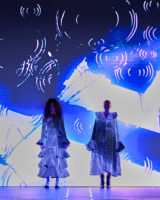
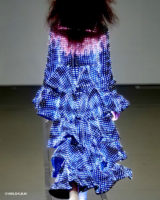
Morinaga used this abstracted concept of human evaporation to create his real-world vanishing act. A large screen was projected with animated cityscapes and digital signage, calling to a romanticisation of Tokyo’s technological allure, its concrete streets glowing in sci-fi pinks and greens. Models walked structured garments, created in collaboration with LED Tokyo, in front of the screen. The garments then, like a chameleon, glitchingly conformed to the projected world behind them, effectively vanishing the body.
Anrealage’s experiments in wearable technology have infected contemporary culture. The brand crossed into mainstream cultural visibility when Beyoncé wore a custom Anrealage LED dress as she performed her haunting ballad Daughter during her Cowboy Carter Tour.
The digital condition of the LED garments was starkly contrasted by a series of softer looks. Though anchored in the present, they felt like a video game-ification of the spat-out debris of a 20th-century time warp. 1970s romantic psychedelia was manipulated into skeletal armour. A jacket was embedded with neon shop-window signage, flashing gently under a gauze of fabric. Binary code infected garments like a virus. Models carried antiquated telephones, frantically muttering under their breath, evoking images of ‘The Controller’ from Doctor Who’s Satellite 5. They carried swords and wore bracelets and neck pieces that mimicked early LED technology.

‘The Controller’ from Dr Who’s Satellite 5.
Ultimately, Anrealage asks what happens when we attempt to disappear in a world where ‘era’ and technology have been smooshed into one big pulsating mass of Frankensteinian culture. Can clothes, like the thermo-camo in Ghost in the Shell, blend the human body into the world around it? Can one hide in plain sight? Like a pair of oversized tacky sunglasses at the airport, sometimes garity is the best form of human camouflage.
