









To “become part of the furniture” often implies a familiarity so enduring that you’re no longer noticed—you blend in; you disappear. Yet when you start wearing the furniture itself, the opposite occurs. HODAKOVA returned this season, continuing her fascination with transforming household objects into wearable garments. Suffice to say, you’re not exactly blending in when your dress once belonged to a velvet-upholstered antique chair.
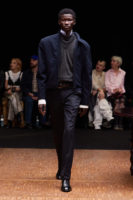
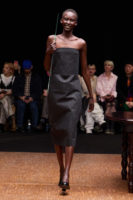
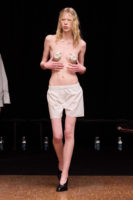
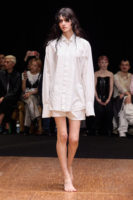
Presenting her FW26 collection, 2024 LVMH Prize winner Ellen Hodakova devoted the season to exploring the vulnerability of personal style in public and the private sensitivity of those who express it. Playing on this theme—and taking “business at the front” quite literally—each look appeared perfectly composed from one angle, but as soon as the models turned the corner, bare backs and boxer shorts betrayed the illusion.
The set resembled a stripped-back home: a Persian rug, a few wall panels, and not much else. In a muted palette of tobacco, ash, black, and bone, front-facing city hustlers wore sharply tailored tuxedo jackets with matching skirts or trousers, their side seams left open to reveal unfinished panels.
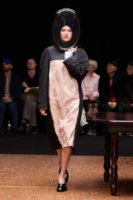
Tweed overcoats with exposed hems, matching skirts, and hats appeared with crisp shirts and V-neck sweaters layered underneath. These pieces marked a new collaboration with Harris Tweed, sourcing fabrics directly from Scotland and continuing Hodakova’s commitment to honest and traceable craftsmanship.
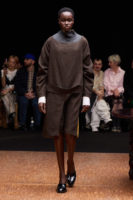
As the show continued, textiles deepened into velvet with a rich brown shirt-and-trouser look anchored by a matching overcoat. Fur and shearling coats were carried, clutched against the body, paired with leather racer gloves, all crafted from sheepskin, a nod to Hodakova’s Swedish roots. Models initially walked barefoot, but when footwear finally appeared, it was in the form of riding boots and wedges.
A shift into more unconventional materials was marked by the return of a bustier dress constructed from leather belts—a Hodakova signature—followed by models holding mirrors to their faces, confronting both themselves and the audience. These mirrored props were paired with crisp white shirts, dresses, and boxers, perpetuating the show’s focus on exposure and self-reflection.
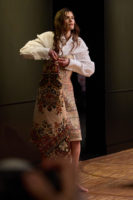
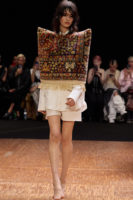
By the end, the garments themselves became furniture: teacups as bras, Persian rugs as skirts, mirrors as headpieces, horsehair strings fashioned into tops, and finally, a short series of upholstered chair dresses. Even the jewellery was upcycled from silver spoons.
Despite its playful and experimental tropes, the collection felt decidedly commercial, proving that wearable (at least from the front) doesn’t have to mean quiet or expected. Although it may be that, after all this contemplation on identity and vulnerability, one might wish to become part of the furniture again—if only for the comfort of disappearing.
