Dear Shaded Viewers,
Martin Parr’s posthumous collaboration with Uniqlo, unveiled today at the Louvre, felt less like a product launch and more like a carefully staged farewell from a photographer who understood, perhaps better than anyone, how images circulate in contemporary life.
Parr died on 6 December 2025, just days after shooting a fashion story for Vogue Italia in the Italian Alps, working literally until the end. Gravely ill but fully lucid about his prognosis, he continued to accept commissions and plan new projects, including this collaboration with Uniqlo and the Louvre, which was conceived and developed before his death. The result, presented today, is explicitly framed as a posthumous collection, but it bears all the hallmarks of his own decision-making: a wry look at spectatorship, tourism, and how we behave in front of art.
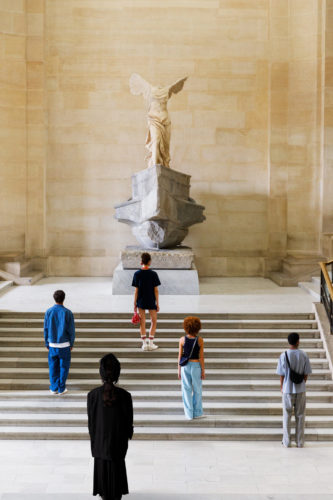
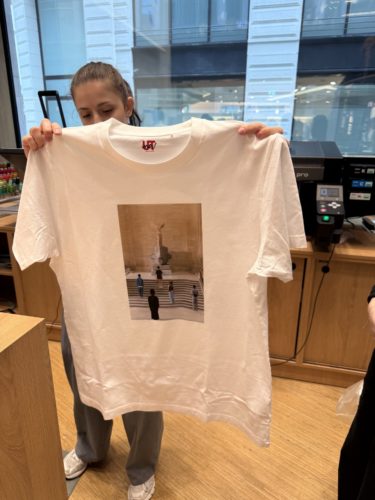
The press conference closed with a gesture that was pure Parr. Journalists and guests were invited to stand with their backs to the camera in a pre‑staged scene in the museum, so that each person could later receive a Uniqlo T‑shirt printed with their silhouette inside a Parr-composed photograph. The act folded everyone present into his visual universe, turning the audience of this tribute into subjects and consumers at once, exactly the kind of meta-image he relished.
Who Martin Parr was
Born in 1952, Parr became one of the most recognisable documentary photographers of his generation, celebrated for his saturated colour, close-up flash, and ruthless yet oddly affectionate scrutiny of middle-class leisure culture. From seaside resorts and package holidays to supermarkets and political gatherings, he built a visual anthropology of the “normal people” he claimed as his primary subject. His long-term series such as Small World and Common Sense dissected tourism and global consumerism, showing how similar rituals repeat from Blackpool to Benidorm to Bangkok.
At the same time, Parr was an astute, even ingenious businessman. He embraced editorial fashion work, corporate commissions, museum shops, books, merchandising, and foundations as extensions of his practice rather than compromises. That openness to opportunity—always on his own terms—made collaborations like Uniqlo not an aberration but a logical continuation of his strategy to push documentary imagery into mainstream circulation. Even in his final months, as the Jeu de Paume prepared its major retrospective and Vogue Italia commissioned what would become his last fashion story, he treated every new brief as another way to test how far his vision could travel.
Magnum, controversy, and a new idea of reportage
Parr’s role within Magnum Photos remains central to understanding his importance. He joined Magnum as an associate in 1988 and became a full member in 1994, in a vote so contentious that he won by a single ballot. Traditionalists within the agency bristled at his brash colour, his frontal flash, and his focus on the banal rather than on wars, revolutions, or the standard heroic tropes of photojournalism. Philip Jones Griffiths openly opposed his admission, and Henri Cartier-Bresson is reported to have seen his work as coming from “another planet.”
Yet that “other planet” is precisely what made Parr pivotal. Once inside Magnum, he not only thrived but eventually served as its president from 2013 to 2017, helping steer the cooperative into a digital, diversified era where long-form reportage could coexist with fashion stories, personal projects, and brand collaborations. His success effectively widened the definition of who could be considered a reportage photographer: irony, subjectivity, and constructed scenes were no longer disqualifying. In this expanded space, photographers such as Alec Soth—whose lyrical, subjective narratives sit far from classic conflict reportage—could be perceived as fully legitimate heirs to the Magnum tradition. Parr’s presence made the agency porous to new sensibilities, proving that you could be critical, humorous, and commercially savvy and still help redefine documentary practice.
If the Louvre event today offered a wearable, playful memorial, the Jeu de Paume is currently staging the more canonical one. The exhibition “Martin Parr. Global Warning,” conceived with the artist before his death, brings together about 180 works spanning from the 1970s to 2024, reframing five decades of his photography through the lens of the Anthropocene and global excess. Curated by Quentin Bajac, who is also director of the Jeu de Paume, the show presents Parr’s humour as a planetary alarm system: laughter as a form of unease, visual pleasure tinged with guilt.
The exhibition has become one of the cultural events of the season in Paris, with queues snaking around the Tuileries on a daily basis and tickets becoming increasingly hard to obtain in its final weeks. Inside, visitors encounter a photographer who refused any moral high ground, frequently acknowledging his own complicity as a traveller and consumer. In this light, the Uniqlo collaboration feels less like merchandising and more like another medium: the T‑shirt as a portable exhibition panel, worn out into the very world his images scrutinise.
Uniqlo’s UT x Louvre collection with Martin Parr positions itself at a crossroads of fashion, art, and institutional branding, yet its real charge comes from its timing. Developed before Parr’s death, it now reads as a self-authored epitaph that is as wry as any of his pictures: crowds in museums, phones held aloft, tourists performing culture for the camera. By inviting today’s press to become literal participants in one more staged scene, the project extends his life-long interest in how we look, how we are looked at, and how those images are then monetised, circulated, and worn.
In that sense, this collaboration encapsulates the contradictions that made Parr so important. He was a rigorously critical observer who also understood branding; a documentarian of excess whose own work fuelled the image economy; a divisive figure at Magnum who ended up reshaping its identity and opening doors for a new generation of photographers who, like Alec Soth, privilege mood and narrative over traditional “decisive moments.” Today at the Louvre, surrounded by both institutional gravitas and fast-fashion pragmatism, Martin Parr’s vision proved once again that the everyday—handled with enough intelligence and irony—can be monumental.
Later,
Diane