










For KidSuper’s FW26 show Outside the Box, a large cube sits anxiously on a red-carpeted runway. Chaotic scenes of Paris explode across its surface in a film written and directed by the brands founder and creative director Colm Dillane. The camera settles on Vincent Cassel, lost, running through the streets. Windows, security cameras and people begin to glitch, eroding any certainty of reality. It collapses into blinding white, leaving Cassel suspended in exitless space.
The cube slowly raises to reveal an agitated model, confused amongst a sea of wooden school chairs.
MODEL: Who are you. Whats Happening. Whats going on.
A generated voice ‘resets’ him and he drops to the floor unconscious. The model is loaded onto a stretcher by two suited security guards and carried off.
VOICE: Do not be afraid. Everything is under control. What you are about to see is not real. What you are about to see is not real. Sit back and relax and enjoy the human show.
The models enter the runway.
The theatrical prologue establishes the space not for the viewing of clothes, but for the construction of a total fictitious reality. Dillane is using fashion as an anchor for a much larger, ambitious, multi-disciplinary practice. Do these clothes exist in reality, or in someone else’s fantasy?
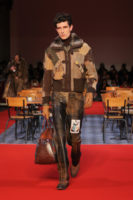
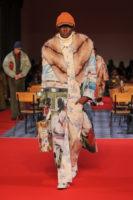
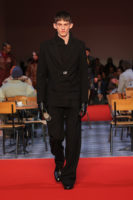
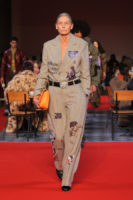
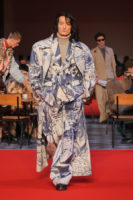
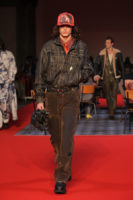
Fragments of culture [painting’s, advertisements, film posters etc.] are stitched together to mimic a woven tapestry. Large jackets looked like they had been dipped into fluid film stills. An Andy Warhol lookalike where’s a sleek black leather two piece imitating Willem Dafoe in The Grand Budapest Hotel. He holds an upturned glass of wine; another carries upside-down iced coffee, both refusing physics.
A male model is draped in Fanny Bryce’s fur jacket from Funny Girl. Hello, gorgeous. Elsewhere, a suit jacket glitches in it’s tailoring, unable to settle within a single plane of time, overlapping itself, melting between. Another suit appears stuffed and tied at the ends, as if a character from Pulp Fiction were dissolving into a scarecrow.
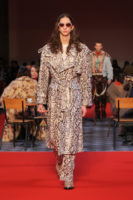
There is a lush overindulgence of fur and animal print: a model drowns in layered leopard-print jackets lined with red silk and reptilian trousers, another mimicking Zoolander’s iconic snakeskin suit.
A hot and heated mess of culture has been moulded into a procession of humanity. Dillane presents a wearable experience. Something pulled from the cracks, where the self is at its most potent: the psychological abstraction and glitching qualities of real/fake existence. Within that instability, the human state intensifies. Amplified into a fragmented world of high, male glamour. An exoneration of historic inspiration. The adoration of the icon. An ineluctable assertion of power. A study of the destabilised man of/within a collapsing structure. Like Andy Warhol’s celebritisation of his own broken existence, or the dandy pimp glamourising sexual commerce, the show proved fashion as a mechanism of veneration. How it can inflate something broken into a cultivated fantasy of itself.
The audience completes the cycle of veneration, coerced into to the role of worshipper and disciple. KidSuper succeeded in cultural canonisation by deconstructing the machinery of a fashion show; the show itself becoming the ritual apparatus.
The models slowly congregate on the wooden chairs after performing their individual coded mazes of the runway. They interact as though they are not being observed.
The cube slowly lowers, containing all the models inside.
Cassel is re-instated in a stable reality. A café. He dances destructively to ‘La Foule’ by Edith Piaf.
‘Fin’ erupts in red.
The cube raises once more, releasing the models to a remix of ‘Non je ne regrette rien’ . They exit as though resetting, the show poised to repeat indefinitely.
