

Dear Shaded Viewers,
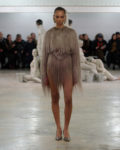
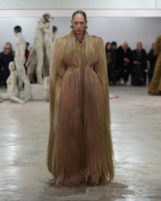
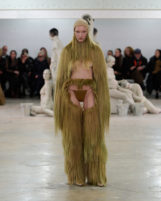
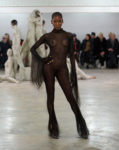
After a decade away from the runway, Charlie Le Mindu returned to Paris not with a show, but with a film you could walk into, a live sequence of bodies moving through light, scent and hair. SKINS, his SS26 couture collection, unfolded less as a collection reveal than as a durational performance where women of every shape and presence kept the narrative alive before, during and long after the last look crossed the runway. It was not a pre-show and a finale; it was a continuous score of bodies insisting on being seen on their own terms.
Born in Bergerac and trained at the French Hair Academy from the age of thirteen, Le Mindu cut his teeth in the nightlife of Berlin, doing “live cuts” in clubs like White Trash and Barbie Deinhoff’s, fusing hair, performance and spectacle long before fashion caught up. From those underground salons, he rose as a pioneer of haute coiffure, showing wig collections from 2009 and collaborating with artists and houses from Lady Gaga to Vivienne Westwood, Mugler and Chanel, while building an art practice that treats human hair as sculptural medium, emotional relic and cinematic prop. In the early years of A Shaded View on Fashion Film, his work slipped into the festival’s programs like fragments of a fever dream—concept films where hair, body and costume were already narrating beyond the frame, previewing the immersive language that would culminate in SKINS.
That decade away from the runway was not an absence but a laboratory. Designing for opera and ballet, from Les Ballets de Monte-Carlo to Berlin and Marseille, and shaping performances, music videos and editorial shoots, Le Mindu honed a practice where movement leads form, and costume becomes an extension of flesh rather than its disguise. In SKINS, that research returns to fashion as a kind of live cinema: every silhouette carries the tension of a close-up, every entrance and exit reads like a cut, and the women moving through the space—lingering, looping, watching—become both protagonists and witnesses.
SKINS is not about exposure; it is about presence. The collection operates at the quiet intersection of power and desire, speaking to those who choose how they are seen, when they are touched and where their boundaries lie. Sexuality here is deliberate rather than decorative, sensuality inhabited rather than performed for applause: you can be desired and autonomous, soft and confrontational, fully visible without belonging to anyone. There is a punk discipline in this refusal to soften the message—no ironic distance, no euphemism—just the body, amplified instead of corrected, telling the truth.
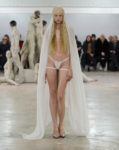
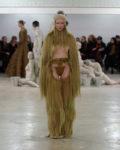
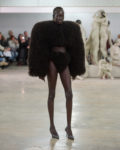
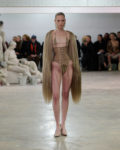
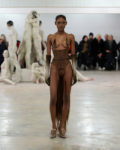
Visually, SKINS is an ode to trichophilia pushed to its most radical conclusion: hair is no longer ornament, it is structure, surface and architecture. Each look is crafted entirely from real human hair, the fiber treated as both skin and armor, draped, woven and engineered into a second epidermis that clings, swings and shimmers like a moving close-up. Color is held in check so the material can speak—dark, luminous, almost wet under the light—while glass beads, fantasy pearls and points of light read as pores or freckles rather than jewelry, a couture language written directly on the body. The result is a series of silhouettes that hover between the natural and the constructed, questioning beauty standards and gender codes without ever apologizing for their own intensity.
The staging only deepened the cinematic charge. Women of all shapes inhabited the space as a performance piece in itself: arriving before the official start, holding their poses and trajectories during the show, and lingering after the last look, they broke the usual temporal frame of a couture runway. Instead of a linear narrative, the audience moved through overlapping scenes—an exchange of looks here, a slow unfurling of hair-skin there—more akin to an experimental film installation than a traditional fashion presentation. The camera, whether literal or imagined, seemed always in motion, cutting between bodies, details, gestures, the choreography oscillating between control and release, intimacy and distance.
The alliances behind SKINS underscore its stakes. Pornhub’s support, marking its first presence at Couture Week, anchors the collection in a discourse of sexual autonomy rather than sanitized desirability. As Alex Kekesi notes, the collaboration is not about exposure, but about individuals defining their own boundaries, with Le Mindu’s history as a former sex worker lending a rare authenticity to a fashion space that often exploits what it pretends to celebrate. In parallel, BYREDO extends the work into the invisible: scent and makeup become tools of presence rather than cover, with hair perfume and touch-based pigments turning each body into a moving archive of collective memory and emotion. The show didn’t just look like something; it smelled, lingered and haunted like the final scene of a film you can’t quite leave behind.
Other early responses have framed SKINS as a decisive pivot from the rhetoric of “body positivity” to the more urgent demand for “body visibility,” noting how Le Mindu refuses to edit the body into something acceptable. Reviews have highlighted the way hair-as-skin destabilizes usual fashion hierarchies: couture techniques are deployed not to idealize the body, but to underline its reality, weight and autonomy. Critics attuned to his performance history see SKINS as a synthesis of his worlds—club, stage, museum and runway collapsing into one charged environment where clothing is only one of many narrative devices.
For ASVOFF, SKINS lands like a full-circle moment. Those early festival films, shown alongside the likes of Rick Owens and other boundary-pushers, already treated hair and the body as cinematic protagonists rather than accessories. Today, that same impulse has stepped off the screen and into the room, with Le Mindu offering not simply an image of the body, but a state of being: unedited, autonomous, fully present. In a season crowded with clever concepts, SKINS reads as something rarer—a live film written in human hair and human choice, where the credits never really roll.
Designer & Creative Director — Charlie LE MINDU
Art Director — Florence TÉTIER
Stylist — Samia GIOBELLINA
Makeup Artist — Karin WESTERLUND
Hair Stylist — Mélissa ROUILLÉ
Nail Artist — Lora DE SOUSA
Casting Director — Conan LAURENDOT
Choreography — Grace LYELL
Jewellery — Stephanie D’HEYGERE
Textile Designer — Léa DOMINGUES
Shoes — ABRA
Lighting Director — Olivier SIMOLA
Soundtrack — Nils BÖ
Production — RAW MATTER
Press – KARLA OTTO
Invitations — Baptiste GERBELOT-BARILLON & Studio Gui BOUCHER
Design 1st Assistant — William RAEGAN
Atelier — Tarren GARCIA, Charlotte ABALÉ GNAHORÉ, Caroline ELIE, Joffrey GIL
Image
Live Director — Nicolas COULOMB
DOP — ATALIA
Lookbook Photographer — Jean MARQUES
Performance Videographer — Sally MOORE
Runway Photographer — Csaba KORNÉL VÁGÓ
BTS Photographer — Ibrahim ELHINAID
BTS Photographer Beauty — Renata KATS
BTS Videographer — May WIRTZ
Special Thanks : Alyson Cox, Antoine Gagey, Claire Vital, Jennifer Sarkis, Jonathan Moscatelli, Kelly Cutrone,
Maria Pelo, Ménagerie de Verre, Myriam Le Mindu, Nirina Metz, Novembre Magazine, Paris College of Art,
Peaches, Ryn Major, William Raegan
Later,
Diane