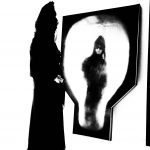


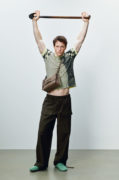



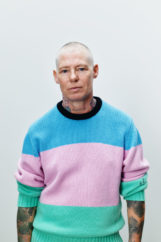


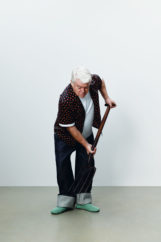


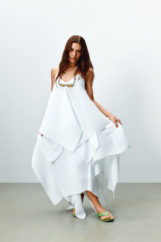


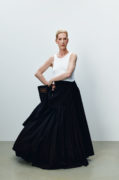
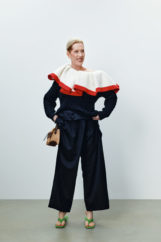


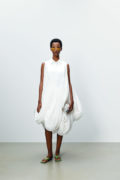


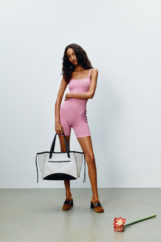


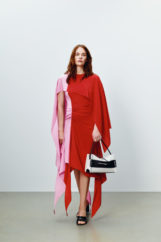


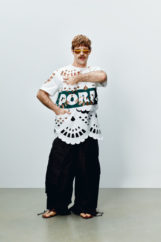


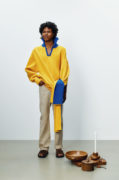


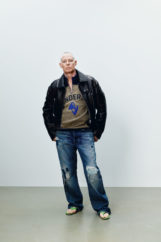
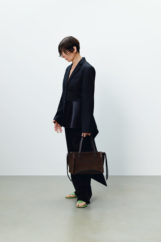


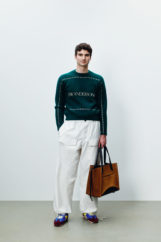


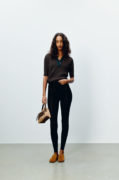

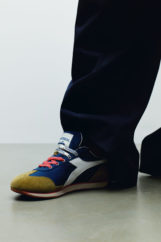
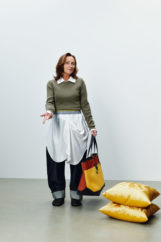
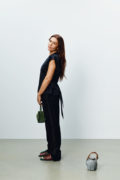



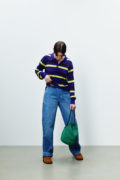
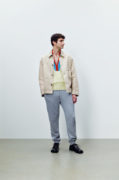
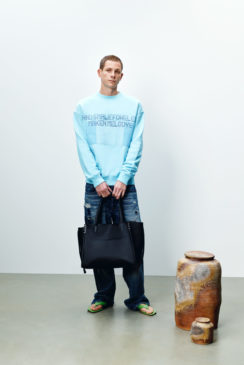
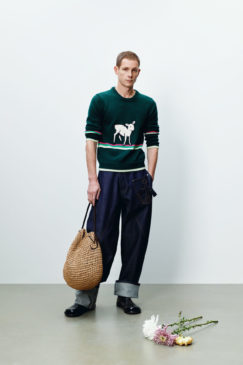
Jonathan Anderson’s AW26 JW Anderson lookbook reads like an intimate interior rather than a runway, and that shift in format is the key to understanding how it sits beside the grand theatre of his Dior era. At Dior he is recoding a monument through choreographed shows and museum-like sets, while here he builds a lived-in universe where clothes, objects and friends quietly form a portrait of how he wants to exist in the world.
The AW26 collection is framed as a curated ecosystem of “things and people I like and I would like to have around me,” folding craft, furniture, textiles and friends into a single narrative. Instead of seasonal spectacle, the second iteration of the JW Anderson lookbook becomes the main storytelling device, populated by a close-knit circle of collaborators and acquaintances who stand in for the usual show cast.
Craft is declared the core: crochet in lace and wool crawls over skirts and dresses, moving from open argyle meshes to denser floral reliefs, while draping swells into exaggerated, almost sculptural volumes. Plant graphics and cartoonish characters, lifted from vintage ephemera, are screen printed with a conservator’s care, insisting that surface decoration, too, has an origin story.
At Dior, Anderson’s task is to decode and recode the house’s language: Bar jackets in Donegal tweed, rococo embroideries and long capes are staged in a gallery-like set modeled on Berlin’s Gemäldegalerie, complete with museum masterpieces and a tightly controlled mise-en-scène. The emphasis there is on theatre and continuity, using the runway to dramatize heritage, whereas JW Anderson AW26 strips away the fanfare and turns the “show” into a book and, ultimately, into the boutique itself.
The deranged, twisted classics he pioneered under his own name—bombers, knotted dresses, playful knits and gender-agnostic “not so basic basics”—reappear in AW26 as familiar characters in a quieter story. Where Dior relies on front-row ceremony and institutional gravitas, JW Anderson leans into a more domestic, almost diaristic scale, proposing slow luxury that feels closer to heirloom than headline.
There is a continuous thread of craft running from Loewe’s ceramics and the Craft Prize through to this JW Anderson lookbook and into his reworking of Dior codes. In AW26, provenance is spelled out: knitwear from Ireland and Scotland, historic damask woven in England, denim from Japan; the garments carry their own production captions like footnotes stitched into seams.
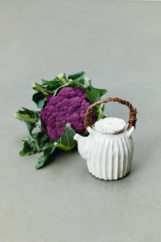
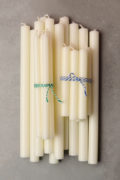
The objects deepen that language: Hope Spring Chairs and Milking Stools by Jason Mosseri, Mac Collins’s chairs, antique gardening tools and oak homeware from Mouseman, Akiko Hirai’s ceramics and Bronze Peach paperweights conceived with Luca Guadagnino turn the collection into a cabinet of curiosities. At Dior, the cabinet becomes architectural—the Bar jacket, archival dresses and Lady Dior bags metamorphosed with charms and surrealist motifs—but the obsession with the maker’s hand and the story behind each piece is the same.
If Dior is a proscenium, JW Anderson AW26 is a salon. The lookbook foregrounds the makers themselves: Mosseri posed with his Milking Stool, Mac Collins with his Iklwa Chair, Polly Lyster wrapped in her hand-dyed textiles, recasting artisans as central characters rather than invisible suppliers.
Alongside them, a polymath cast—Kylie Minogue, Justin Vivian Bond, Ruth Wilson, Tim Blanks, Margherita Missoni and others—collapses the distance between fashion, cinema, music and writing into a loose, convivial community. It echoes the way his recent brand relaunch leans on friends and long-term collaborators in the imagery, positioning JW Anderson less as a label and more as a social, creative ecosystem that runs parallel to, and occasionally seeps into, the more codified world of Dior.
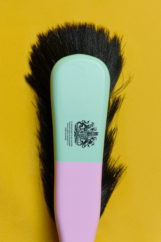
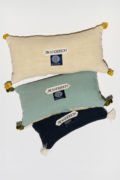
The timing intensifies the dialogue between the two projects: as Anderson’s Dior collections roll out in stores and online, celebrated for their fusion of archival references and modernity, JW Anderson is evolving into a holistic lifestyle proposal where clothes, objects and interiors are presented as one continuous gesture. At Dior, he is responsible for an entire canon; at his own house, he is free to show “how I live, what I collect,” turning the commercial space into a living installation that can expand to include gardening tools, brushes, cushions or sketchbooks without apology.
Seen together, the AW26 lookbook and the Dior runway recodings demonstrate two sides of the same project: a designer intent on making craft and community the backbone of fashion, whether through velvet-lined Beaux-Arts rooms in Paris or a book of friends in London holding bombers, damask dresses and Mouseman stools.