
Dear Shaded Viewers,
Embroidery, or tatreez, is not only a craft but a soft architecture of memory, mapping a land that has been repeatedly redrawn and uprooted. Each stitch carries the weight of a place, a family, a village; together they form a textile topography where borders are made not by politics but by pattern, color, and touch.
In the nineteenth and early twentieth centuries, Palestinian women spoke to one another in thread, composing dresses that told stories of origin, status, and desire. A chest panel could whisper of a specific village, a cuff could signal marital status, and a hem might recall the hills, orchards, or coastal light of home. Across regions, embroidery generated a quiet, shimmering chorus of difference, each area known for its own palette, density of stitch, and rhythm of motif.
Tatreez emerged from intimacy with nature: branches, stars, cypress trees, and flowers reimagined through cotton and silk, indigo and madder, as if the landscape itself had been invited to rest on the cloth. Indigo grown in the Galilee bled into fabric like twilight, while palms, wheat sheaves, and amulets unfurled along the body, granting protection as much as adornment.
The rural origins of tatreez never limited its grandeur; they deepened it. Wedding dresses, heavy with golden thread and dense with motifs, were wearable constellations, shimmering archives of labour, love, and aspiration. Mother-of-pearl shoes caught the light with each step, and elaborate headdresses transformed brides into living reliquaries of local craftsmanship.
Silver jewellery, worn close to the skin, echoed the protective force of certain motifs, turning bodies into thresholds where danger was warded off and fortune invited in. Clothing did not merely cover the body; it negotiated with the unseen, harnessing the belief that beauty itself could shield, bless, and empower.
In 1948, the catastrophe of displacement tore people from their homes, but it could not unpick the threads that bound them to place. In the wake of the Nakba, tatreez shifted register, becoming a banner of continuity, a portable homeland carried on shoulders and tucked into wardrobes scattered across camps and cities. A dress could now hold the memory of a village no longer accessible, its patterns standing in for orchards lost, wells abandoned, doors left ajar.
Embroidery began to move from domestic privacy into the public arena, appearing in political posters, on uniforms, and within solidarity movements, transforming from intimate language to collective declaration. Each cross-stitch became a refusal to forget, a refusal to accept erasure; a small act of resistance multiplied across countless hands and garments.
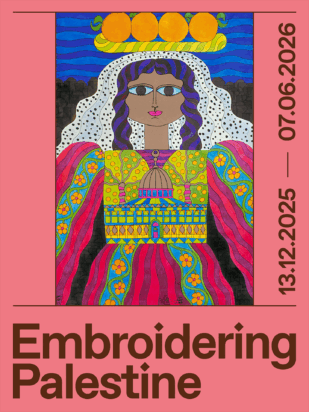
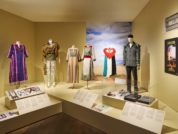
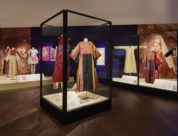
The exhibition Embroidering Palestine at MoMu – Fashion Museum Antwerp gathers this living history, laying out dresses, jackets, headdresses, and jewellery like pages from an unwritten book. Loans from collections in Paris, Leiden, and the Netherlands bring together garments that once moved through fields and wedding halls, now suspended in museum light, inviting close attention to every seam.
Contemporary designers such as Ayham Hassan, GmbH, Reemami, Studio Nazzal, and Zeid Hijazi extend these stories forward, quoting, fragmenting, and re-situating motifs in silhouettes shaped by present-day urgencies. Their work suggests that tatreez is not a relic but a living script, capable of writing new futures while remaining anchored in ancestral forms.
Guest curator Rachel Dedman approaches these textiles as one might approach a complex poem: by listening to cadence, pause, and emphasis. Her longstanding engagement with Palestinian embroidery and Middle Eastern fashion allows garments to be read not only as beautiful objects, but as witnesses to changing roles of women, shifting economies, and the long arc of political struggle.
In this exhibition, curating becomes a gesture of care and reconnection. By bringing together rural dresses, urban finery, and avant-garde designs, the show allows threads to cross that history had tried to cut, inviting visitors to feel how a single stitch can hold nature, splendour, power, and change all at once.
Embroidering Palestine runs from 13 December 2025 to 7 June 2026 at MoMu – Fashion Museum Antwerp, opening a space where cloth becomes both testimony and horizon.
Later,
Diane