Dear Shaded Viewers,
humanité — a chorus of faces, a geometry of tenderness
From Basquiat’s searing self-portrait to Bouabré’s rainbow benedictions, La Fab. gathers a living atlas of us: intimate, unruly, and incandescent.
Walk in and the room is already breathing: a riot of colors sketched across time, a murmured prayer stitched in human hair, a cartography of crowds from the beach to the boulevard. This is humanité — a journey through the agnès b. collection that treats the human condition not as a thesis but as a pulse, as portraiture and protest, as the quiet gravity between two people sharing a plate of rice.
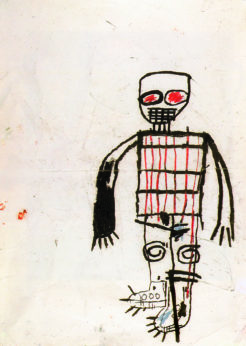
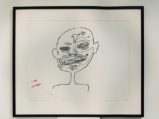
The portraits hold the gaze first: Seydou Keïta and Malick Sidibé framing elegance as an everyday right; the camera not as witness so much as an accompanist to dignity’s music. Jean-Michel Basquiat’s Self-Portrait (1983) cuts through the air with raw voltage, a totem of self-assertion and ancestry that refuses the polite margins of Eurocentric narratives. Mona Hatoum’s Keffieh (1998), embroidered with human hair, turns memory into filament and resistance into skin-close poetry — a soft shock that lingers in the body.
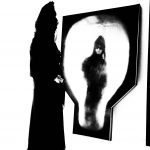
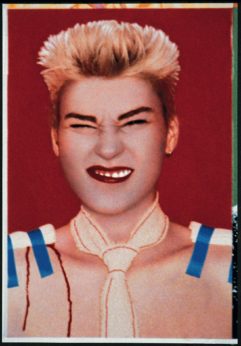
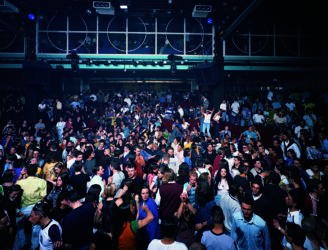
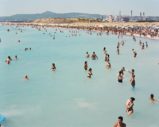
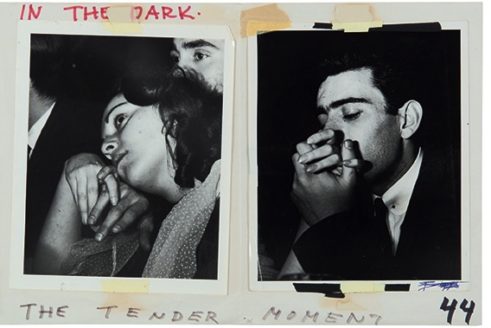
Step back and the individual dissolves into chorus. Gilbert & George stage their double-image as both satire and vow; Martin Parr scans the theater of everyday desire with a wink that stings; Massimo Vitali’s high-vantage panoramas unfurl like social weather maps, each figure a pinprick story, the whole a humming organism of leisure, longing, and coincidence.
Here, the couple becomes a small republic. Richard Billingham’s Ray and Liz is tenderness with its sleeves rolled up, truth unvarnished and luminous at once. Queer desire draws its own syntax in Jared Buckhiester’s line — free, precise, unabashedly tender — while Keïta’s couples occupy the frame with quiet sovereignty, proof that intimacy can be both radical and ordinary.
What if the human is a rehearsal? Adrien Beau’s La Petite Sirène, wired and skinned in unlikely materials, is a fable you can almost touch. Annette Messager’s Deux clans, deux familles rearranges childhood detritus into a study of power and belonging, where softness becomes strategy. Pascal Doury’s collaged anatomies fracture and reassemble the body, insisting that identity remains a work-in-progress — provocative, playful, unresolved.
Alighiero e Boetti lets craftswomen stitch the globe into flags — a world both bordered and bound together, geopolitics rendered through patient hands. Frédéric Bruly Bouabré answers with a bright chorus: 200 drawings saluting women of the world, alongside visions where humanity gathers around a single bowl, sacrality found in the simplest communion. Chéri Samba paints with wit and clarity, skewering injustice while keeping the canvas open to laughter — critique as celebration, color as call.
La Fab. is more than a venue; it is a house of continuities, planted at Place Jean-Michel Basquiat and designed with the same lucid tenderness that shapes the collection. Its endowment fund extends the exhibition’s thesis into the city: long-standing commitments to HIV/AIDS work, to those living in extreme precarity, to migrants at sea — with current support for SOS MEDITERRANEE — turning gallery walls into a prologue for action.
humanité runs from November 20, 2025 to March 22, 2026, at La Fab, with extended hours midweek and weekends to catch the work in different light. Press and public programming will braid these artworks with live conversations and encounters, so the show keeps breathing — a shared table, a new map, a face in the crowd that looks suddenly like yours.