











Dear Shaded Viewers,
Mich Dulce’s journey, for me, traces back decades—long before her name adorned international runways. In the early days, when she lived in Paris and the pulse of her career was just quickening, she presided over a shop tucked near the Palais Royal—a gemstone of millinery and creativity that drew in the city’s most adventurous dressers. Years before global accolades, before she became a force at Maison Michel Paris and Chanel, Dulce was already weaving together her fierce vision and Filipino heritage in that intimate Parisian atelier. The world would soon recognize her: British Council International Young Fashion Entrepreneur of the Year (2010), Chevening Scholar (2019), and an artist whose talent claimed a place at the nexus of sustainability, craft, and couture.
To step into Dulce’s universe was always to encounter both rigor and rebellion. Her technical fluency—refined at Central Saint Martins, London College of Fashion, FIT New York, and Ecole Lesage—is now legend, the kind boldly displayed at London and Paris Fashion Week. Few in millinery can straddle such disparate worlds: she’s at once the Assistant Artistic Director for Maison Michel Paris—the hat atelier of Chanel—and Industry Mentor for the Chanel and The King’s Foundation Métiers d’Art Millinery Fellowship. Yet her roots remain unshakably Filipino, a counterforce to European lineage, her hats alive with stories, memory, and revolt.
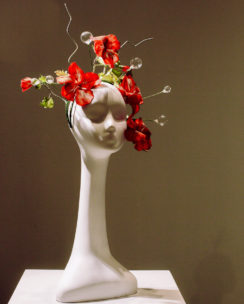
Dulce’s millinery draws autobiography outward and into the collective. Her hats become talking heads—literal sites of Filipino animated culture-making. She unspools Western millinery codes and grafts them onto Filipino terrains: salakot wide-brimmed hats burst into scarlet ribbons, rice terraces carve themselves into verdant crowns, and Ilocano gourd hats illuminate the tension between tradition and transformation. In her hands, a banig mat or a bahay kubo nipa hut can metamorphose into wearable sculpture, memory-as-insurgency.
What sets Dulce apart—now, as then—is a philosophy anchored in ethical transformation. Her millinery is built with sustainable materials like handwoven T’nalak by the T’boli women, and guided by the principles of preserving tradition, empowering communities, and minimizing waste. Dulce’s hats are not mere ornaments, but lasting, well-made archives of Filipino craft, as much statements as they are objects.
Through her improbable material entanglements and ironic refractions, Dulce produces rebellious temporalities—posing new ways to (re)fashion national identity out of fragments and refusals. Her practice is neither ethnographic revival nor Western mimicry, but a wild language that bends haute couture until it is unrecognizable, audacious, and urgent. Even global icons like Lady Gaga, Celine Dion, and Anna Dello Russo have gravitated toward the phantom allure—and meaning—encoded in her creations.
Across decades, countries, and careers, Mich Dulce’s hats remain radical spirit-bearers. Whether nestled in a shop off Palais Royal or breaking ground on international stages, she fashions memory, identity, and rebellion into wire, palm, and abaca. Hers is an artistry that does more than adorn—it refuses erasure, weaving together the intimate and the insurgent with every fold, stitch, and crown.
Later,
Diane