













Dear Shaded Viewers,
If you’ve spent the last decade watching Demna turn Balenciaga into fashion’s most thrilling, divisive, meme-generating house, you might have expected his final couture show to be a riotous send-off. But in Paris today, Demna’s swan song was something else entirely: a study in restraint, intimacy, and the kind of quiet conviction that only comes from knowing you’ve already changed everything.
The crowd outside the Balenciaga atelier on Avenue George V was a who’s who of fashion’s inner circle—Kim Kardashian, Naomi Campbell, Lorde, and a smattering of the industry’s most influential editors. Inside, Sade’s “No Ordinary Love” set the mood: elegiac, nostalgic, and a little bit defiant. This wasn’t just another couture show. This was Demna’s last word at Balenciaga, and everyone knew it.
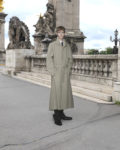
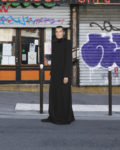
Demna’s final collection was less about spectacle and more about soul. Instead of the architectural maximalism that’s become his signature, he delivered sculptural tailoring and anatomical cuts that whispered rather than shouted. Tulip lapels stood like armor, Medici collars stretched into gothic silhouettes, but there was a surprising softness beneath it all. Corsetry was reengineered for comfort, hourglass forms cradled rather than constrained, and even the house’s famed volumes seemed to float rather than overwhelm.
Technical silk bombers and taffeta blousons blurred the lines between streetwear and couture. A seamless puffer coat and vicuña-cashmere maxi nodded to Demna’s penchant for the unexpected. Corduroy was transformed, trompe-l’œil style, into a sentimental homage to Demna’s childhood—the first pair of trousers he ever wanted to wear.
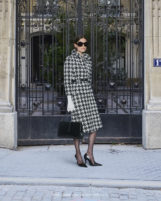
Demna’s references were subtle, sometimes subconscious. A houndstooth “Danielle suit” recalled Balenciaga’s 1967 heyday. A 1957 floral motif appeared not on a gown but a sequined skirt suit and handbag—a wink to his grandmother’s kitchen tablecloth. Sentimentality and sharpness coexisted, and the effect was quietly devastating.
As the final model exited, Demna took his bow. There was no grand gesture, just a sense of closure. After a decade of disruption, he leaves Balenciaga not with a bang, but with a collection that feels like a love letter to fashion itself—one that’s as much about beginnings as endings.
“Thirty-five years later, this show reconnects me to the beginning of my vision. It’s a tribute to fashion that has a point-of-view,” Demna wrote in his show notes.
With Demna off to Gucci, and Pierpaolo Piccioli waiting in the wings, the house stands at another crossroads. But today belonged to Demna: the designer who made us question what luxury means, who turned the runway into a conversation, and who—just this once—let silence speak louder than spectacle.
In a world obsessed with noise, Demna’s last Balenciaga couture show was a masterclass in the power of restraint. The era of Demna at Balenciaga is over, but the echoes will linger—quietly, defiantly, beautifully.
Later,
Diane
SHOW NOTES
This collection is the perfect way for me to finish my decade at Balenciaga. I have come as close as possible to being satisfied in this endless pursuit of impossible perfection—the defining ethos of Cristóbal Balenciaga.
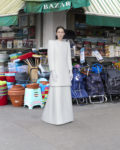
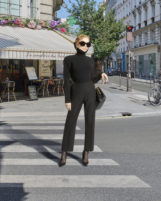
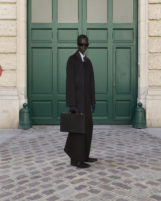
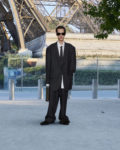
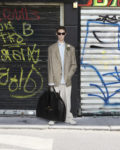
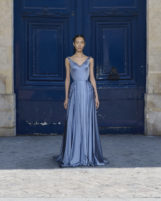
The looks are photographed throughout Paris—a tribute to the place where I began my fashion career.
Garments are sculptural and intricate in their construction, while embracing minimalism and reduction in their architecture. Notions of lightness and comfort feature throughout, alongside an exaggerated hourglass created using reengineered “comfortable” corsetry.
The starting point for the collection was a study of the dress codes of “La Bourgeoisie.” Severe and monumental tailoring for women with tulip lapels that frame the face, alongside high-collared, constructed Medici and Nosferatu-esque necklines.
Couture renditions of archetypal garments form my ultimate wardrobe—building on what I consider the raison d’être of this métier as something that needs to exist outside the ballroom.
The lightest possible technical silk bomber jacket; a “business” blouson in summer-weight taffeta, followed by the airiest car coat ever. A puffer coat with no side seams and a cashmere-vicuña maxi coat are cut with a biker attitude. Corduroy is realized as a trompe-l’œil in 300 km of tufted embroidery—the first “corduroy” pants I want to wear.
References to M. Balenciaga run throughout—consciously, and subconsciously. The Danielle suit, a recreation of a houndstooth ensemble she wore in 1967, is cut with the Cristóbal Balenciaga attitude she embodies.
A 1957 floral motif is applied to a sequined, pattern-matched skirt suit and handbag—evoking my grandma’s kitchen tablecloth from my childhood.
The finale look worn by Eliza is a seamless Guipure lace gown shaped with millinery techniques—the ultimate minimal sculptural gown that represents everything this House stands for.
The Golden Age of Hollywood, a perpetual obsession of mine informs a study of Old Hollywood glamour. A black sequined “Diva” gown inspired by Marilyn Monroe, a pink “Debutante” princess dress in the world’s lightest technical organza. A draped dress cut with one seam.
My ode to Elizabeth Taylor is worn by Kim: a “mink” coat made of embroidered feathers, worn over a Cat on a Hot Tin Roof silk slip. To complete this tribute, she wears Elizabeth Taylor’s most iconic personal diamond pendant earrings from Lorraine Schwartz’s private collection.
Tailoring developed with 4 family-run ateliers from Naples follows the unstructured Neapolitan style pioneered by Vincenzo Attolini. 9suits, created as “one-size-fits-all” ensembles made-to-measure on a bodybuilder, are worn by models with various body types. It is not the garment that defines the body, but the body that defines the garment.
Inspired by Elizabeth Taylor’s love of jewelry, Lorraine Schwartz created over 1,000 carats of custom-made high jewelry with white diamonds, natural emeralds, Padparadsha sapphires, pink diamonds, and canary yellow diamonds to accessorize the collection.
2 fans are recreated from the archives of Duvelleroy—the most “eccentric” couture accessory.
Logos on handbags with the most refined constructions are replaced with the name of the wearer.
Flower brooches are crafted by Maison Lemarié and William Amor using discarded tissue paper collected from the atelier floor and silk pongee.
The 1st Balenciaga Couture sneaker, a standard runner, is handcrafted using traditional shoemaking techniques.
Briefcases are given a new purpose, reimagined as “jewelry box” laptop case.
Finally, the soundtrack features all the wonderful people from my teams—who have helped me realize my vision for this house over the last decade—saying their names.