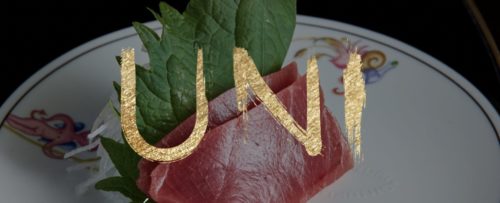
A stone’s throw from Avenue Montaigne, a restaurant manages to act both as an intimate place and a wide open door to the delicacy of Japanese excellence. UNI means sea urchin in Japanese, a creature that hides its finest treasures from view, and this restaurant is no different. The space unfolds in three acts: a first room evoking the gilded screens of imperial Japan, a second in dialogue with prints and Japanese art, and a private salon for eight inspired by the residences of samurai. The room can be privatised. Oh and “let me flame the foie gras on your wagyu” is, from now on, my favorite sentence.

At the helm is Singaporean chef Akmal Anuar, the most decorated chef in the Michelin Guide UAE, holder of a Michelin star for his Dubai restaurant 11 Woodfire and formerly head chef at Iggy’s in Singapore, ranked number one in Asia at the World’s 50 Best in 2012. At UNI, he brings that accumulated rigour to a proposition that is both deeply rooted in Japanese tradition and entirely alive to where it has landed. The fashion world has taken note. The creative duo Victoria/Thomas was among the first approached by the restaurant after opening, invited to help draw a fashion audience into what UNI describes as a more conceptual setting. The instinct was correct. This is a room that understands the relationship between precision, ceremony and beauty that fashion has always understood. It belongs in both worlds without choosing between them.
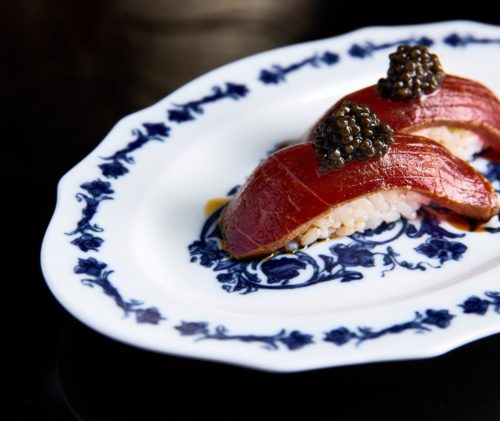
That evening, the room had been granted something rare: a front-row seat to The Art of Tuna. A whole, monumental tuna, brought to the centre of the room, to be cut before every table. Dima explains what sushi masters teach their apprentices: before the tuna is touched, it must be mourned. Recognised. He then proceeds with a meticulousness that is genuinely moving to witness. A young apprentice stands beside him, learning by observation alone. The tuna is introduced in its three registers. The akami first: ruby-red, the most authentic expression of the fish, its flavours direct and unmediated. Then the chutoro, bicoloured, negotiating between lean and fat, delicate and round in equal measure. Finally the otoro, the ventral part, marbled like great wagyu, dissolving on contact. In Japan, as Dima explains, fat in fish is quality. Not excess. Precision.
Around this ceremony, the rest of the evening arranges itself with the same sense of gradation. The sake begins sparkling and barely dry, almost weightless, a modern entry point. It deepens as the meal progresses, a Dassai 45 arriving with more body, drier, with real weight. The movement from contemporary to traditional, from the familiar to the irreducible, is felt in every glass. Strangers at neighbouring tables become, briefly, part of the same ritual. And for those who have grown weary of indifferent service in this city, it is worth noting that what happens here is extraordinary. (Ask Antoine, who knows the subject inside out and couldn’t be more kind.)
This is a room that understands the relationship between precision, ceremony and beauty that fashion has always understood. It belongs in both worlds without choosing between them.
UNI, 10 rue de la Trémoille, Paris 8. Tuesday to Saturday.