


Dear Shaded Viewers,
Tiffany Bouelle is stepping into these years like a comet finally entering the constellation it was always meant for—what is thrilling is having witnessed the spark before anyone had a name for its light.
She first arrived in my life as a five‑year‑old shadow on set, quietly orbiting her mother Kanako, the stylist who worked with me when I was a fashion editor at JOYCE, already absorbing the silent codes of image, gesture, and composition. The shoots were her first informal art school: clothes, bodies, cameras, a choreography of adults obsessed with how a line falls or how a colour catches the light. It felt natural, almost inevitable, a few years later—around seven—I invited her into the frame, asking her not only to appear but to cast and style for my video with Disciple Films on the designers As Four; she answered that invitation with a precocious precision, as if she had always known how to edit reality into a story.
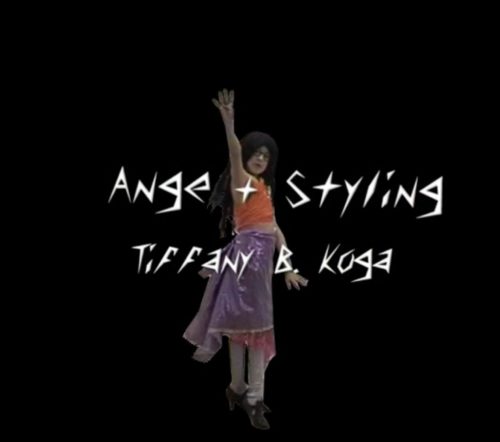
That early collaboration drew a through-line that would later become a working relationship when she joined me as an intern, no longer the child watching from the corner but a young woman testing the limits of her own language. What I had sensed then—that a life in images and ideas was not just likely for her, but unavoidable—has since unfolded with a clarity that now looks like destiny. Both parents, Kanako with her stylist’s eye and her father with his own creative sensibility, gave Tiffany not just an artistic environment but permission to inhabit it fully, to treat art less as a career move and more as a way of being in the world.
Today, Tiffany describes herself as a painter, performer and muralist, but those labels barely contain the scope of her research. Between 2016 and 2022, she undertook a vast, almost anthropological project around the female body, meeting more than three hundred women around the world and translating their intimate narratives into an abstract, calligraphic visual language. These were not decorative gestures; they were inscriptions of what is rarely shown—injunctions, invisible wounds, internalized fragilities—converted into line, stain, and rhythm on canvas. Institutions hesitated; Tiffany did not. She kept collecting, listening, transforming the raw material of confession into a pictorial archive of what it means to inhabit a woman’s body under pressure.
The birth of her son in 2022 closed that initial cycle and opened another: a tender, unflinching exploration of post-partum, its physical and emotional aftershocks, and the ghostly memory the body keeps of rupture and repair. This period culminated in a performance at Galerie Porte B, created in the thick of her own post-partum, where the act of making became indistinguishable from the act of surviving. From there, her gaze widened—from the body to the planet that contains it. Her research now moves from the human figure to the “body of the living”: plants, flowers, insects that tenaciously persist in hostile environments become metaphors of resistance and memory. For over a year she has been developing a series on ruined landscapes where each flower is not consolation but a prognosis—the living of tomorrow, emerging from what we destroyed, asking how we feel when confronted with collapse and climate crisis rendered not as data but as fragile, insistent bloom.
What marks Tiffany’s current work is an intense physical engagement with scale, repetition, and risk. At Galerie Patrick Mestdagh in Brussels, where her first major solo show “L’éloge de l’ombre” opened in early 2026 and has been extended through April, she inaugurated the exhibition with a five‑hour public performance, uninterrupted. This was not endurance for spectacle’s sake; it was a meditation carried out with the whole body, the result of months of training in a process that is both rigorous and vulnerable. Painting with the canvas turned toward the wall, she courts the possibility of failure—paint can flow unpredictably, gravity can betray her, a single uncontrolled movement can compromise hours of work—yet this very risk is what opens the work to chance, making the painting a trace of a lived interval rather than a controlled image.
The genesis of this method leads back to an autumn in Japan, where Tiffany began each dawn by painting a monumental flower, using large scale to structure space and composition, each bloom silently registering her fatigue or exhilaration that day. These morning rituals became a travel diary without words, a serial practice that disciplined both body and mind. For Brussels, she decided to reveal the fruit of those months of constraint, producing eight works in a single afternoon, a feat she herself once considered impossible. The paintings are proof of what persistence and repetition can unlock: not virtuosity as display, but a new threshold of attention where the painter’s body becomes simultaneously tool, matter, and language.
The arc of her career now aligns with one of art history’s most charged stages: Venice. In May 2026, as the city opens the 61st Biennale, Tiffany enters the newly created Fondazione Maddalena Di Giacomo, located in Palazzo Vallier in San Polo, a few steps from the Rialto bridge. She joins the permanent collection with her painting “It’s my party and I cry if I want to”, installed as a kind of ritual threshold: visitors will be invited to formulate a wish and blow out a candle in front of the work before beginning their journey through the foundation. The institution itself is born from a fiercely matriarchal lineage—a collection of female portraits, antique perfumed objects, sentimental jewellery, amassed over a lifetime by Maddalena Di Giacomo, an anticonformist figure active in music, publishing, dance, and art—and curated by Alexandra Mazzanti to honour the emotional histories of women so often erased from official narratives.
Within this context, Tiffany presents two works in the collective exhibition “La Nota Mancante” at Palazzo Vallier, whose opening on 22 May will include a performance in the “Salon des Souhaits”. This room, the first monumental permanent environment created by the artist, gathers a corpus of works around the theme of desire, immersing viewers in a space that is at once mystical and sensorial. The fresco, painted from late April through May 2026, anchors an exhibition dedicated to the tenacity of memory to cross time, in dialogue with other artists including Vivan Meir, Giorgione, and Therese Schwartze. It is also the prelude to her carte blanche for the 62nd Venice Biennale in May 2028: a solo exhibition titled “Les fleurs naissent dans les ruines” (“Flowers are borned in the ruins”), a series she has been building for three years, whose first manifestations have already appeared at TEFAF Maastricht and will travel to the Château de Malloret under the curatorship of Yoyo Maeght.
In this cycle, Tiffany interrogates what insists on appearing where nothing should grow: what arises in the interstices, what survives in the rubble, what lifts itself from exhaustion toward a new form. Each work is a delicate balance between memory and transformation, collapse and rebirth, asking a daring question: how can a woman artist today address war not as an illustration of suffering or a political slogan, but as an authentic investigation into the concept of war itself? As Yoyo Maeght notes, art history has largely entrusted representations of war to male artists; Tiffany’s approach, neither didactic nor militant yet deeply engaged, opens a rare and urgent field of research.
This moment is also one of geographic expansion. At TEFAF Maastricht, one of the art world’s most exacting fairs, five of her works were recently presented, marking a recognised turning point in her trajectory; TEFAF’s platform for emerging artists has long functioned as a threshold into institutional and major-collection visibility, and Tiffany’s inclusion signals the growing attention around her work.
In Paris, from October to December 2026, Galerie Porte B will host “Les vertiges de la douceur”, an exhibition rooted in a feminist vision where Tiffany continues her practice of dialogue with artisans. For three previous solo shows, she has chosen to foreground a different woman artisan each time, co‑creating volumetric pieces shaped by the artisan then reinterpreted by Tiffany through colour and form—an ongoing celebration of collaborative making.
For this Paris chapter, she collaborates with ceramist Mathilde Martin and with Julie, a French coutelière, who will present a collection of knives inspired by Tiffany’s work. These objects, far from decorative accessories, become extensions of her pictorial vocabulary into three dimensions: tools that cut, protect, and signify, reimagined through a feminine lens. What once was a little girl drifting through fashion sets now orchestrates immersive rooms, international fairs, and multi‑layered collaborations, her practice rooted in the same intuitive grasp of image and narrative I witnessed on those JOYCE shoots—only now, the scale is planetary.
TIFFANYBOUELLE.COM
Instagram @tiffanybouelle
Later,
Diane
